Global Trade Relations 2026: Impact on US Exports & Imports

Anúncios
Global Trade Relations 2026: Navigating the Future of US Exports and Imports
The global economic landscape is in a constant state of flux, shaped by geopolitical shifts, technological advancements, and evolving policy frameworks. As we look towards 2026, the trajectory of international trade, particularly for the United States, is poised for significant transformation. New tariffs, emerging trade agreements, and renewed focus on national interests are all contributing to a complex, yet fascinating, future for US exports and imports. Understanding these dynamics is not just for economists; it’s crucial for businesses, policymakers, and consumers alike to strategize and adapt. This comprehensive analysis will delve into the projected state of Global Trade 2026, examining the critical factors that will redefine America’s position in the international marketplace.
Anúncios
The past few years have been marked by a period of increased protectionism, supply chain disruptions, and a re-evaluation of globalization. These trends are not ephemeral; they are laying the groundwork for the trade environment we will experience in 2026. From the resurgence of industrial policies to the digital transformation of trade logistics, every element is contributing to a mosaic that will dictate the flow of goods and services across borders. Our exploration will cover the broad strokes of macroeconomic trends, pinpoint specific sector-level impacts, and offer actionable insights for navigating this evolving terrain.
The Shifting Geopolitical Chessboard: What Drives Global Trade in 2026?
The foundation of Global Trade 2026 will undeniably be built upon the geopolitical realities of today and tomorrow. Major global powers continue to recalibrate their relationships, often through the lens of economic security and strategic independence. This has led to a noticeable shift away from purely multilateral trade agreements towards more bilateral or regional pacts, or even unilateral actions like targeted tariffs.
Anúncios
The Role of US Trade Policy in Shaping 2026
US trade policy, regardless of the administration in power, is expected to maintain a focus on protecting domestic industries, ensuring fair trade practices, and leveraging economic influence to achieve broader foreign policy objectives. This could manifest in several ways:
- Targeted Tariffs: While broad-based tariffs might see some adjustments, strategic tariffs on specific goods or from particular countries are likely to persist or even expand, especially in sectors deemed critical for national security or technological leadership. These tariffs aim to level the playing field or incentivize domestic production, directly impacting import costs and export competitiveness.
- New Trade Agreements: The US may pursue new free trade agreements (FTAs) with allies or expand existing ones, prioritizing partners that align with its strategic interests. These agreements often go beyond traditional goods trade, incorporating provisions on digital trade, labor standards, and environmental protections, setting new benchmarks for Global Trade 2026.
- Supply Chain Reshoring and Friend-shoring: A significant policy push will continue to be the diversification and strengthening of supply chains. This involves encouraging companies to bring production back to the US (reshoring) or to allied nations (friend-shoring), reducing reliance on potentially volatile regions. This will directly affect import volumes and the geographic distribution of manufacturing.
Major Global Players and Their Influence
Beyond the US, other major economies will play pivotal roles. China’s economic policies, including its Belt and Road Initiative and its drive for technological self-sufficiency, will continue to reshape global supply chains and trade routes. The European Union’s regulatory environment, particularly concerning digital services and environmental standards, will also have a far-reaching impact on companies trading with the bloc. Emerging economies in Southeast Asia, Africa, and Latin America will increasingly become important markets and production hubs, altering the traditional North-South trade dynamics.
Tariffs and Trade Agreements: A Detailed Look at 2026 Projections
The interplay of tariffs and trade agreements will be a defining characteristic of Global Trade 2026. These tools are not just economic instruments; they are powerful levers of geopolitical influence and industrial policy.
The Evolution of Tariffs: Beyond a Simple Tax
Tariffs in 2026 are unlikely to be a one-size-fits-all solution. Instead, we can expect a more nuanced application:
- Strategic Tariffs on Critical Goods: Expect continued or new tariffs on goods related to advanced technology (e.g., semiconductors, AI components), rare earth minerals, and certain medical supplies. These are often imposed not just for economic reasons but also for national security and technological supremacy.
- Environmental Tariffs/Carbon Border Adjustments: As climate change becomes a more pressing global concern, the implementation of carbon border adjustment mechanisms (CBAMs) could become more widespread. These tariffs aim to equalize the price of carbon between domestic products and imports, penalizing goods from countries with less stringent environmental regulations. This will significantly impact energy-intensive industries and their export markets.
- Retaliatory Tariffs: The potential for retaliatory tariffs remains a constant threat. Disputes over intellectual property, subsidies, or market access could trigger tit-for-tat tariff impositions, leading to volatility in specific trade lanes.
The New Landscape of Trade Agreements
While the World Trade Organization (WTO) continues to face challenges in reaching consensus on multilateral agreements, regional and bilateral deals are gaining prominence. For Global Trade 2026, these agreements will be crucial:
- USMCA (United States-Mexico-Canada Agreement): This agreement will continue to govern a significant portion of North American trade. Its rules of origin, particularly for the automotive sector, will drive investment and sourcing decisions within the continent.
- CPTPP (Comprehensive and Progressive Agreement for Trans-Pacific Partnership): Although the US is not a member, the CPTPP’s influence on trade in the Asia-Pacific region is undeniable. US businesses will need to navigate its provisions when dealing with member countries.
- Emerging Bilateral Deals: The US may pursue new bilateral agreements with key partners in Europe, Asia, or other regions, focusing on specific sectors or strategic alliances. These agreements could offer preferential access for US exports in exchange for various concessions.
- Digital Trade Provisions: Increasingly, trade agreements will feature robust chapters on digital trade, addressing data localization, cross-border data flows, and digital services. This is critical for the growing digital economy and will shape how tech companies operate globally.
Sector-Specific Impacts: Who Wins and Who Loses in 2026?
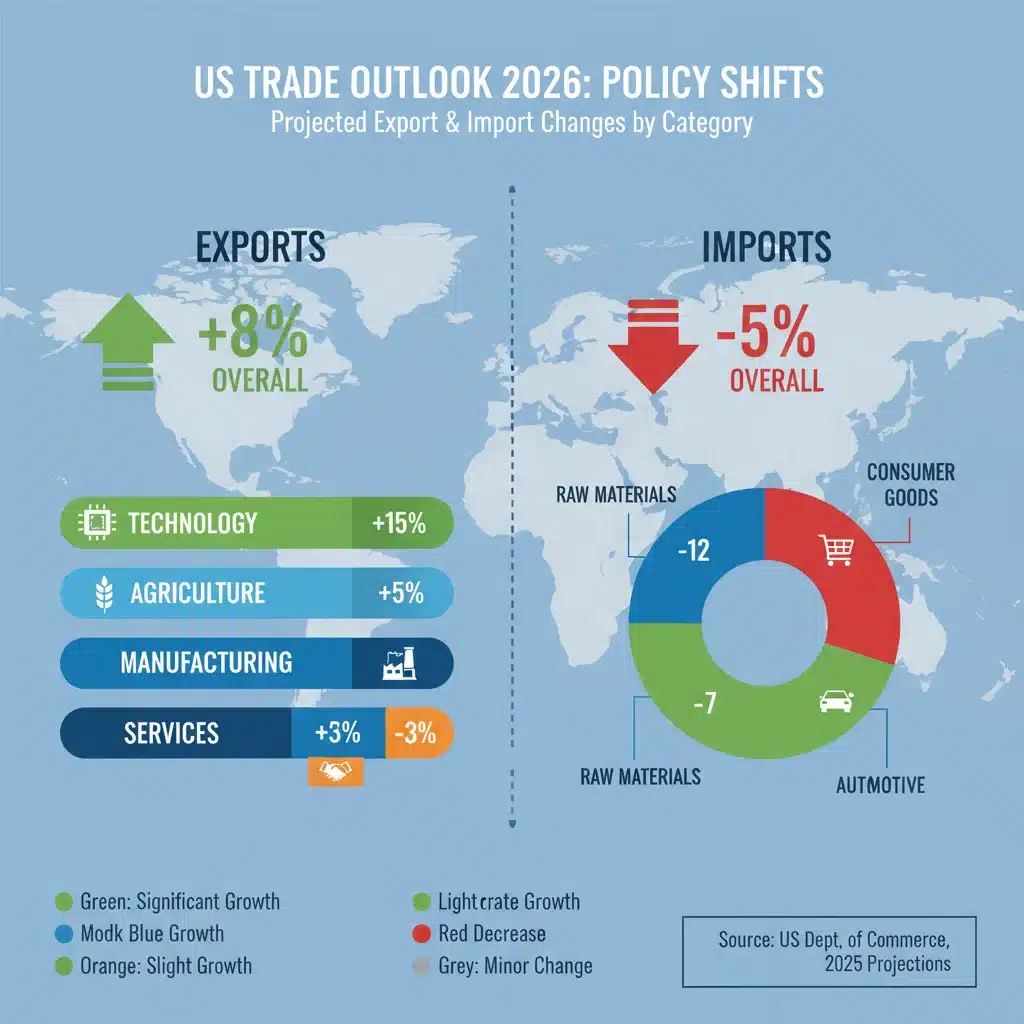
The broad strokes of trade policy translate into very specific outcomes for different industries. Understanding these sector-level impacts is vital for strategic planning in Global Trade 2026.
US Exports: Opportunities and Challenges
- Agriculture: US agricultural exports remain a cornerstone of the economy. Tariffs from major importers can significantly impact profitability. However, new trade agreements or geopolitical shifts opening new markets could provide substantial opportunities. The demand for sustainable and organic produce is also a growing export niche.
- Technology and High-Tech Manufacturing: This sector faces a dual reality. On one hand, export controls on sensitive technologies to certain countries may tighten. On the other hand, demand for US innovation in AI, biotechnology, and advanced manufacturing remains high globally. Protecting intellectual property in international markets will be paramount.
- Energy: The US has become a major energy exporter (oil, natural gas, LNG). Global energy demand, geopolitical stability, and environmental policies in importing nations will dictate the trajectory of these exports. Diversifying export destinations will be key.
- Services: The service sector, including financial services, education, and digital services, continues to be a strong US export. Digital trade agreements and regulatory harmonization will facilitate growth, while data localization requirements in some countries could pose challenges.
US Imports: Shifting Sources and Costs
- Consumer Goods: Tariffs on consumer goods, particularly from high-volume manufacturing hubs, can lead to increased prices for US consumers or force companies to diversify their sourcing. The trend towards nearshoring or friend-shoring could see more imports from Mexico, Canada, or other allied nations.
- Automotive: The automotive industry is highly sensitive to tariffs and rules of origin. The USMCA’s provisions will continue to shape supply chains within North America. The global shift towards electric vehicles (EVs) will also influence import patterns of components and finished vehicles.
- Raw Materials and Intermediate Goods: Industries reliant on imported raw materials (e.g., metals, rare earths) may face higher costs due to tariffs or supply chain disruptions. The push for domestic sourcing or diversification to politically stable suppliers will be a key theme.
- Pharmaceuticals and Medical Devices: The pandemic highlighted vulnerabilities in medical supply chains. Policies aimed at increasing domestic production or securing supplies from a broader range of reliable partners will influence import patterns in this critical sector.
The Impact on Global Supply Chains and Logistics by 2026
The fundamental structure of global supply chains is undergoing a profound transformation, driven by the forces shaping Global Trade 2026. Businesses are no longer solely focused on cost efficiency but are increasingly prioritizing resilience, diversification, and proximity.
Resilience Over Efficiency
The disruptions experienced in recent years have shifted the paradigm from just-in-time (JIT) to just-in-case (JIC) inventory management. This means companies are building in redundancies, holding larger buffer stocks, and diversifying their supplier base to mitigate risks from geopolitical tensions, natural disasters, or unexpected policy changes. This can lead to slightly higher operational costs but greater stability.
Regionalization and Localization
The trend towards regionalization means that companies are seeking to establish production and sourcing within specific geographic blocs (e.g., North America, Europe, Asia) rather than relying on a single global factory. This is often driven by trade agreements that offer preferential treatment within these blocs. Localization, or bringing production closer to the end consumer, is also gaining traction, particularly for goods with high shipping costs or specific market demands.
Technological Advancements in Logistics
The logistics sector will continue to evolve rapidly. AI and machine learning will optimize shipping routes, predict demand fluctuations, and manage inventory more effectively. Blockchain technology could enhance transparency and traceability in supply chains, crucial for compliance with new trade regulations and consumer demands for ethical sourcing. Automation in ports and warehouses will also play a significant role in improving efficiency and reducing labor costs.
Strategic Responses for Businesses Navigating Global Trade 2026
For businesses looking to thrive in the complex environment of Global Trade 2026, proactive strategies are essential. Adaptability, foresight, and a deep understanding of the evolving trade landscape will be key differentiators.
Diversify Supply Chains and Markets
Relying on a single source or market carries significant risk. Businesses should actively explore new suppliers in different regions, especially in countries with stable political relationships and favorable trade agreements. Similarly, diversifying export markets can buffer against downturns or policy changes in any one country.
Monitor Trade Policy Closely
Staying abreast of changes in tariff regimes, trade agreement negotiations, and import/export regulations is paramount. This requires dedicated resources, whether internal teams or external consultants, to interpret policy shifts and assess their potential impact on operations and profitability.
Invest in Technology and Automation
Leveraging technology can significantly enhance competitiveness. This includes adopting advanced analytics for market forecasting, automating aspects of supply chain management, and investing in digital tools for compliance and customs procedures. For manufacturers, advanced robotics and smart factories can improve efficiency and reduce reliance on external labor markets, potentially mitigating tariff impacts.
Strengthen Relationships with Key Stakeholders
Building strong relationships with suppliers, logistics providers, and government agencies can provide invaluable insights and support during times of change. Collaboration and information sharing can help anticipate challenges and identify opportunities in the evolving trade environment.
Embrace Sustainability and ESG Principles
As environmental regulations become more prevalent and consumer demand for ethical products grows, integrating sustainability into business operations is no longer optional. Companies that can demonstrate strong Environmental, Social, and Governance (ESG) practices may find it easier to navigate trade barriers, access new markets, and attract conscious consumers. This is particularly relevant with the rise of potential carbon tariffs in Global Trade 2026.
The Future of Global Trade 2026: A Look Ahead
The landscape of Global Trade 2026 will be characterized by increased complexity and dynamism. While protectionist tendencies and geopolitical rivalries will continue to shape policies, there will also be significant opportunities for innovation, strategic partnerships, and new market development. The push for greater supply chain resilience and sustainability will redefine how goods are produced, moved, and consumed globally.
For the United States, navigating this future will require a delicate balance of protecting national interests, fostering innovation, and engaging constructively with international partners. US exports will find new avenues in emerging markets and high-demand technological sectors, while imports will likely see shifts in sourcing origins as businesses adapt to new trade agreements and tariff structures. The digital economy will continue its ascent, making digital trade policy a central pillar of international commerce.
Ultimately, success in Global Trade 2026 will hinge on agility and a forward-thinking approach. Businesses and policymakers who can anticipate trends, adapt quickly to change, and leverage technology effectively will be best positioned to thrive in this new era of global commerce.
Key Takeaways for 2026:
- Geopolitical Influence: Trade will remain deeply intertwined with international relations and national security objectives.
- Targeted Policies: Expect more precise tariffs and specialized trade agreements rather than broad, sweeping changes.
- Supply Chain Transformation: Resilience, regionalization, and technology will be paramount in logistics.
- Sectoral Divergence: Impacts will vary significantly by industry, requiring tailored strategies.
- Digital Dominance: Digital trade and data governance will be central to new trade frameworks.
By understanding these evolving dynamics, stakeholders can better prepare for the challenges and opportunities that Global Trade 2026 will undoubtedly bring, ensuring continued economic growth and stability in an increasingly interconnected world.