Federal Reserve 5.5% Rate: 2026 Housing Market Impact Analysis
Anúncios
The Federal Reserve’s Interest Rate Decisions: Analyzing the Impact of a 5.5% Federal Funds Rate on the 2026 Housing Market
Understanding the intricate relationship between monetary policy and the real estate sector is crucial for anyone involved in the housing market. As we look towards 2026, the sustained stance of the Federal Reserve’s federal funds rate at 5.5% presents a compelling scenario that warrants detailed analysis. This article delves deep into the anticipated effects of this significant interest rate on the housing market 2026 forecast, exploring everything from mortgage rates and affordability to investment strategies and regional variations.
Anúncios
The Federal Reserve’s Stance and Its Immediate Repercussions
The Federal Reserve, often referred to as ‘the Fed,’ plays a pivotal role in shaping the economic landscape of the United States. Its primary tool for influencing the economy is the federal funds rate – the target rate for overnight borrowing between banks. When the Fed sets this rate at 5.5%, it signals a commitment to controlling inflation, often at the expense of slowing economic growth. This decision reverberates throughout the financial system, directly impacting various lending rates, including those for mortgages.
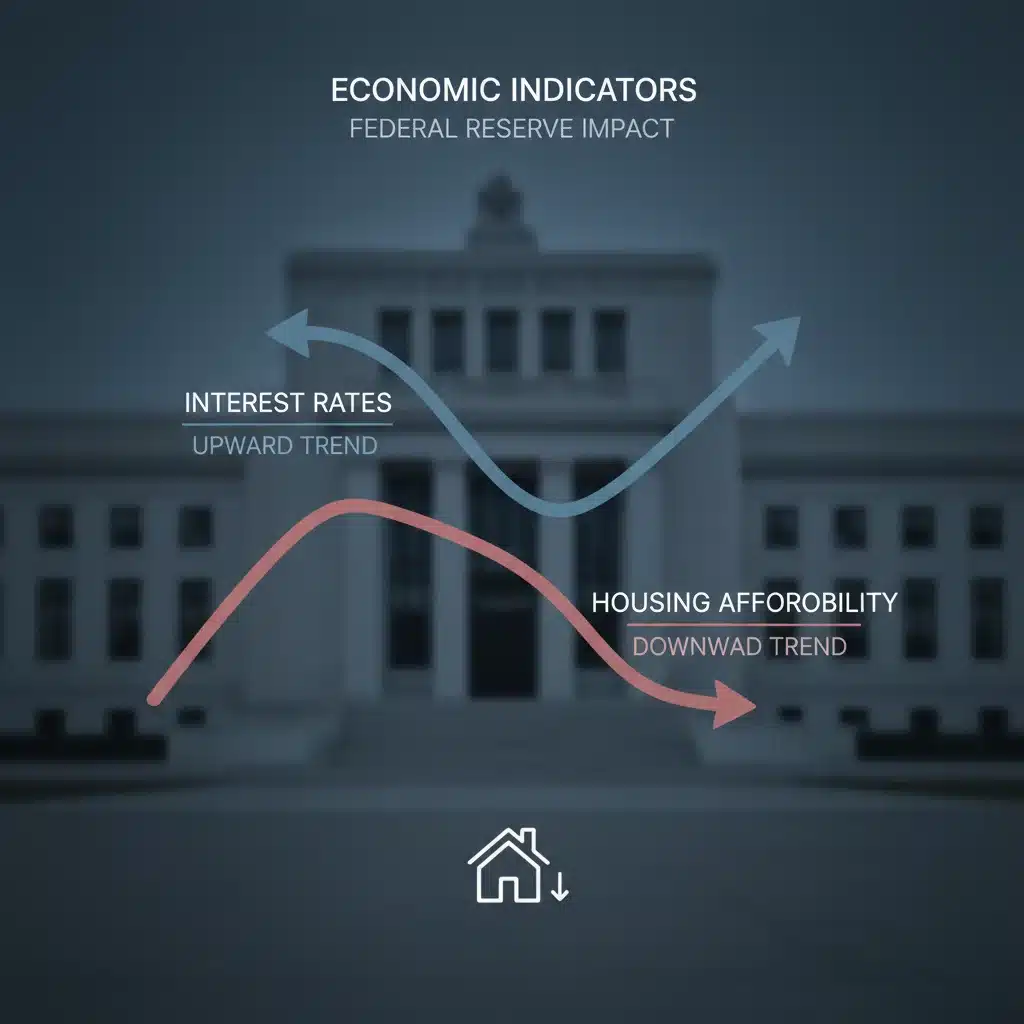
A 5.5% federal funds rate is considered relatively high by historical standards, especially after a prolonged period of ultra-low rates. Such a rate makes borrowing more expensive for banks, which, in turn, pass these increased costs onto consumers and businesses. For the housing market, this translates almost immediately into higher mortgage rates. Prospective homebuyers face increased monthly payments, reducing their purchasing power and potentially cooling demand. This initial shock sets the stage for the broader housing market 2026 forecast.
Anúncios
The Fed’s actions are not taken in isolation; they are a response to prevailing economic conditions, primarily inflation. When inflation is persistent, the Fed uses higher rates to dampen demand, thereby reducing price pressures. While this strategy is essential for long-term economic stability, its short-to-medium term effects on interest-sensitive sectors like real estate can be profound. The 5.5% rate implies that the Fed believes inflation remains a significant concern, requiring a firm hand on monetary policy. Understanding this foundational context is vital for grasping the subsequent impacts on the housing market 2026 forecast.
Mortgage Rates in a 5.5% Federal Funds Rate Environment
The most direct and immediate impact of a 5.5% federal funds rate on the housing market is on mortgage rates. While the federal funds rate is an overnight lending rate for banks, it serves as a benchmark that influences other interest rates across the economy, including those for 30-year fixed-rate mortgages. Historically, mortgage rates tend to move in tandem with the federal funds rate, albeit with some lag and other influencing factors.
With the federal funds rate at 5.5%, we can anticipate conventional 30-year fixed mortgage rates to hover significantly higher than what consumers experienced during the low-rate environment of recent years. While it’s not a direct one-to-one correlation, a 5.5% federal funds rate could easily translate to mortgage rates in the 7-8% range, or even higher, depending on market sentiment, inflation expectations, and global economic conditions. This shift drastically alters the financial calculus for potential homebuyers.
For example, a $400,000 mortgage at 3% interest results in a monthly principal and interest payment of approximately $1,686. The same mortgage at 7.5% interest jumps to roughly $2,797 per month – an increase of over $1,100. This substantial difference significantly reduces the pool of eligible buyers and places immense pressure on housing affordability. The long-term implications of these higher borrowing costs will undoubtedly shape the housing market 2026 forecast, influencing both demand and supply dynamics.
Furthermore, the spread between the federal funds rate and mortgage rates can also widen during periods of economic uncertainty, as lenders price in greater risk. This means that even if the Fed holds the line at 5.5%, other factors could push mortgage rates even higher. Investors in mortgage-backed securities (MBS) will also demand higher yields in a higher interest rate environment, contributing to elevated mortgage costs. These dynamics are critical to consider when projecting the future of the housing market 2026 forecast.
Housing Affordability: A Growing Challenge for the 2026 Housing Market
One of the most pressing concerns stemming from a 5.5% federal funds rate is its profound effect on housing affordability. When mortgage rates are high, the monthly cost of owning a home increases dramatically, even if home prices remain stagnant or experience only modest declines. This affordability crunch disproportionately affects first-time homebuyers and those with lower incomes, effectively locking many out of the market.
The median household income might not keep pace with the accelerated increase in mortgage payments, leading to a widening gap between what people can afford and the actual cost of homeownership. This challenge is further exacerbated in high-cost-of-living areas, where home prices are already elevated. Even with potential price corrections, the combined impact of high prices and high interest rates creates a formidable barrier to entry. The struggle for affordability will be a defining characteristic of the housing market 2026 forecast.
Beyond mortgage payments, other costs associated with homeownership, such as property taxes, home insurance, and maintenance, continue to rise, adding to the financial burden. These factors, combined with higher interest rates, mean that a larger portion of a household’s income must be allocated to housing, leaving less for other essential expenses and savings. This economic squeeze can have broader implications for consumer spending and overall economic growth.
The lack of affordable housing can also lead to increased demand for rental properties, potentially driving up rental costs as well. This creates a challenging cycle where both homeownership and renting become increasingly expensive, impacting the financial well-being of a significant portion of the population. Policymakers and industry stakeholders will need to grapple with these affordability issues as they shape the future of the housing market 2026 forecast.

Impact on Home Prices and Supply in 2026
The relationship between interest rates, demand, and home prices is complex. While higher mortgage rates typically lead to a reduction in buyer demand, which can put downward pressure on home prices, the extent of this impact depends on various other factors, including supply levels, regional economic strength, and population growth.
In a 5.5% federal funds rate environment, we can anticipate a cooling of the rapid home price appreciation seen in recent years. Some markets may experience price declines, particularly those that saw the most aggressive growth and are now facing reduced buyer competition. However, widespread, significant price crashes are less likely in many areas, primarily due to persistent supply shortages. Even with higher rates, the fundamental imbalance between housing supply and demand in many desirable locations continues to provide a floor for prices.
Sellers may become more hesitant to list their homes if they also face the prospect of purchasing a new home with a significantly higher mortgage rate. This ‘lock-in effect’ can further constrain housing supply, preventing a substantial increase in inventory that might otherwise drive prices down more aggressively. Many homeowners who refinanced or purchased during the low-rate era are reluctant to trade their sub-3% or 4% mortgages for a 7-8% rate.
Therefore, while demand will likely soften, the constrained supply could prevent a complete collapse in home prices. Instead, the housing market 2026 forecast might see a period of price stabilization, or even modest declines in some overvalued markets, rather than a broad market crash. This nuanced outlook is critical for anyone trying to predict the future trajectory of real estate values.
Regional Variations and Market Resilience
It’s important to recognize that the impact of a 5.5% federal funds rate will not be uniform across all regions of the United States. Local economic conditions, job growth, population migration patterns, and the existing housing supply will play a significant role in how individual markets respond.
Markets with strong job growth, robust economies, and continued population influx may exhibit greater resilience to higher interest rates. Tech hubs, emerging industrial centers, and areas with diverse employment opportunities might see demand remain relatively stable, even if growth slows. Conversely, markets that experienced speculative buying or are heavily reliant on industries vulnerable to economic downturns could face more significant challenges.
For instance, a market in a thriving metropolitan area with a shortage of new construction might still experience modest price appreciation due to persistent demand, even with elevated mortgage rates. On the other hand, a market in a less economically diverse region that saw a pandemic-era boom might witness more pronounced price corrections as affordability becomes a critical barrier. Understanding these regional nuances is essential for a precise housing market 2026 forecast.
Investors and homebuyers should conduct thorough local market research, focusing on factors like inventory levels, days on market, price reductions, and local economic indicators. A national average often masks significant variations at the local level, and a blanket prediction for the entire country might not accurately reflect individual market realities. The resilience of different regions will be a key theme in the housing market 2026 forecast.
Investment Strategies in a High-Rate Environment
For real estate investors, a 5.5% federal funds rate fundamentally alters the investment landscape. The era of cheap money that fueled significant real estate speculation is likely over, at least for the foreseeable future. Investors will need to adjust their strategies to account for higher borrowing costs and potentially slower appreciation.
Cash buyers will have a significant advantage in this environment, as they are immune to high mortgage rates and can often negotiate better deals. For those reliant on financing, a higher cost of capital means that rental yields must be strong enough to cover increased mortgage payments and other operating expenses. This might lead to a greater focus on cash flow-positive properties and less on speculative appreciation.
Developers may also face challenges. Higher construction loan rates increase the cost of building, which can either be passed on to buyers (further exacerbating affordability issues) or squeeze developer margins. This could lead to a slowdown in new construction, which, paradoxically, could help to keep supply tight in the long run, thereby moderating price declines.
Alternative investment strategies, such as investing in real estate investment trusts (REITs) or focusing on niche markets like industrial properties, senior living, or affordable housing, might become more attractive. Due diligence regarding property valuation, cash flow analysis, and market-specific risks will be more critical than ever. The prudent investor will be one who adapts to the new realities of the housing market 2026 forecast.
The Broader Economic Context and the 2026 Housing Market
The Federal Reserve’s 5.5% federal funds rate is not an isolated policy; it is part of a larger economic strategy aimed at achieving price stability and maximum employment. The success of this strategy, and its ultimate impact on the housing market 2026 forecast, depends on various other economic factors.
Inflation: If inflation proves more stubborn than anticipated, the Fed might be compelled to maintain or even increase rates further, prolonging the period of high mortgage costs. Conversely, if inflation quickly subsides, the Fed might consider rate cuts, which could provide some relief to the housing market.
Employment: A strong labor market can cushion the impact of higher rates by ensuring that consumers have stable incomes to cover their housing costs. However, if the Fed’s aggressive rate hikes lead to a significant slowdown in job growth or an increase in unemployment, housing demand could weaken considerably.
Consumer Confidence: Economic uncertainty and high interest rates can erode consumer confidence, making people less likely to make large purchases like homes. A pessimistic outlook can further depress buyer activity, regardless of other market fundamentals.
Global Economy: International economic conditions, such as geopolitical events, supply chain disruptions, or economic slowdowns in major trading partners, can also influence domestic inflation and the Fed’s policy decisions. These external factors add layers of complexity to any housing market 2026 forecast.
Government Policies: Beyond the Fed, other government policies, such as tax incentives for homebuyers, zoning reforms to increase housing supply, or first-time buyer assistance programs, could also influence the market. These policies can either mitigate or exacerbate the effects of high interest rates.

Navigating the 2026 Housing Market: Advice for Buyers, Sellers, and Owners
Given the anticipated challenges and shifts, various stakeholders in the housing market need to adopt informed strategies as we approach 2026 under a 5.5% federal funds rate scenario.
For Prospective Buyers:
- Focus on Affordability: Re-evaluate your budget considering higher mortgage rates. Prioritize homes that genuinely fit your financial capacity, not just your aspirations.
- Save Aggressively: A larger down payment can reduce your loan amount and, consequently, your monthly payments, making homeownership more attainable.
- Shop for Lenders: Interest rates can vary between lenders. Get quotes from multiple institutions to secure the best possible rate.
- Consider Adjustable-Rate Mortgages (ARMs) with Caution: While ARMs might offer lower initial rates, understand the risks associated with future rate adjustments.
- Be Patient but Prepared: The market might favor buyers more in certain segments. Be ready to act when the right opportunity arises, but don’t rush into an unsuitable purchase.
For Sellers:
- Price Competitively: The days of multiple offers above asking price may be less common. Price your home realistically based on current market conditions and recent comparable sales.
- Enhance Property Value: Focus on necessary repairs and attractive staging to make your home stand out in a more competitive environment.
- Be Flexible: Be open to negotiations on price, contingencies, and closing costs.
- Understand Your Equity: If you have substantial equity, you might be in a better position to navigate a slower market.
- Consult a Local Agent: A knowledgeable real estate agent can provide invaluable insights into your specific local housing market 2026 forecast.
For Current Homeowners:
- Review Your Mortgage: If you have a low fixed rate, consider the implications of moving. The ‘lock-in effect’ is a real phenomenon.
- Build Equity: Continue to pay down your mortgage and consider making extra principal payments if financially feasible.
- Maintain Your Home: Regular maintenance protects your investment and preserves its value.
- Assess Refinancing Options: Unless rates drop significantly, refinancing might not be advantageous, but always keep an eye on market shifts.