Micro-Credentials vs. Traditional Degrees: U.S. Job Market 2026 Analysis
Anúncios
Micro-Credentials vs. Traditional Degrees: A 2026 U.S. Job Market Analysis for Career Advancement
The landscape of education and employment is undergoing a seismic shift, with the traditional four-year degree no longer being the sole arbiter of career success. As we look towards 2026, the U.S. job market is increasingly valuing specialized skills and demonstrable competencies, bringing micro-credentials job market relevance into sharp focus. This article delves deep into the evolving dynamics between micro-credentials and traditional degrees, examining their respective roles in career advancement, economic opportunities, and skill acquisition in the modern workforce.
Anúncios
For decades, a bachelor’s degree was considered the gold standard, a non-negotiable entry ticket to a professional career. While its value remains significant, the rapid pace of technological change and industry evolution has created a demand for more agile, targeted learning solutions. This is where micro-credentials come into play, offering focused, verifiable proof of specific skills. But how do these stack up against the enduring legacy of traditional degrees in the 2026 U.S. job market?
The Rise of Micro-Credentials: A New Paradigm for Skill Acquisition
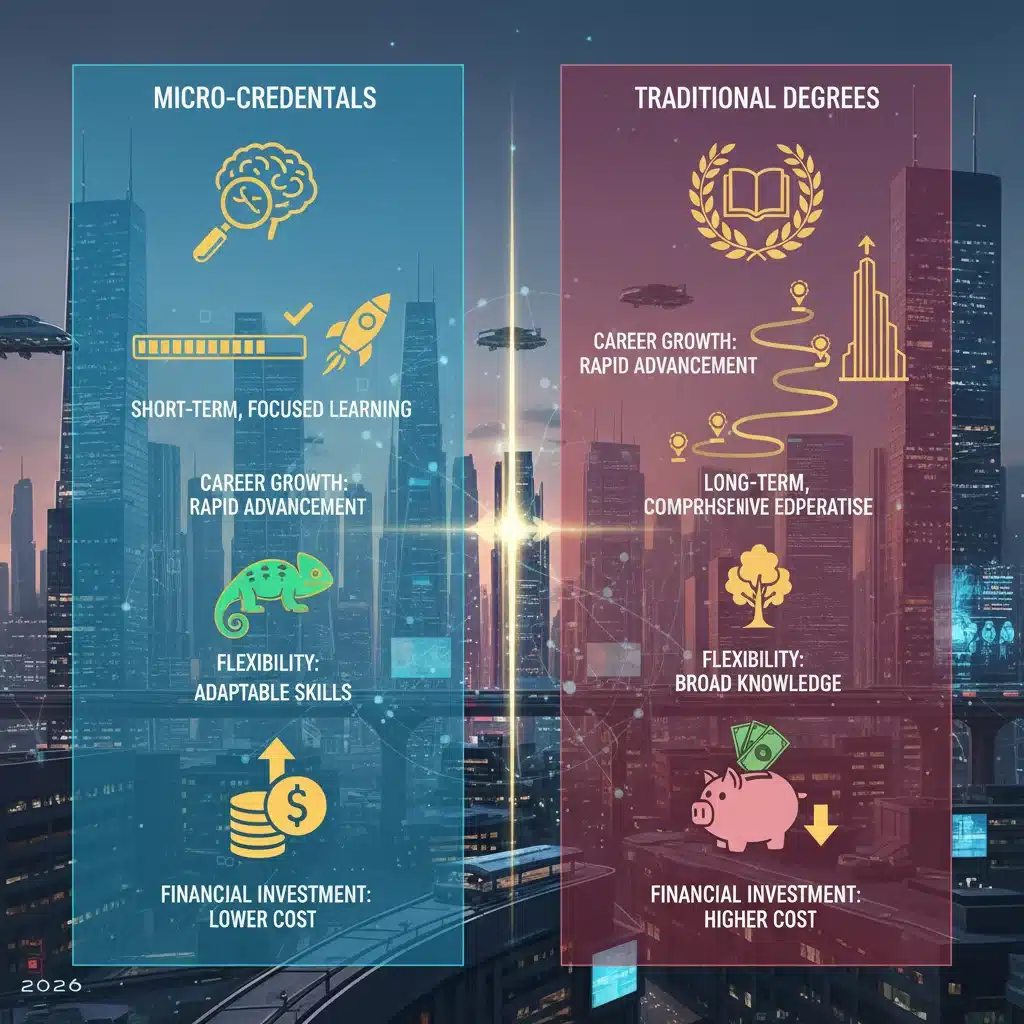
Micro-credentials, often referred to as digital badges, certificates, or nanodegrees, are short-form qualifications that validate specific skills or competencies. They are typically earned through online courses, bootcamps, or vocational training programs, and their appeal lies in their flexibility, affordability, and direct applicability to industry needs. In 2026, the demand for these focused qualifications is projected to surge as companies prioritize skill-based hiring over purely credential-based approaches.
Anúncios
The impetus behind the growth of the micro-credentials job market is multi-faceted. Firstly, the accelerating rate of technological change means that skills can become obsolete much faster than ever before. A traditional degree, while providing a broad foundation, may not always keep pace with the immediate, evolving demands of various industries. Micro-credentials, by contrast, are designed to be nimble, offering quick pathways to acquire in-demand skills such like artificial intelligence proficiency, advanced data analytics, cybersecurity, or specific software development languages.
Secondly, the rising cost and time commitment associated with traditional higher education have made micro-credentials an attractive alternative for many. Individuals seeking to enter a new field, upskill for a promotion, or reskill after a career change can do so without incurring significant debt or taking several years out of the workforce. This accessibility democratizes education and creates more pathways to economic opportunity, especially for underserved populations.
Thirdly, employers are increasingly recognizing the practical value of micro-credentials. They provide a clear, concise signal that a candidate possesses a specific, job-ready skill. This shifts the focus from ‘what did you study?’ to ‘what can you do?’, aligning perfectly with the competency-based hiring models gaining traction across various sectors. The micro-credentials job market is therefore not just about individual learning; it’s about a fundamental re-evaluation of how talent is identified and valued.
Key Characteristics of Micro-Credentials in 2026:
- Targeted Skill Development: Focus on specific, in-demand skills.
- Flexibility and Accessibility: Often online, self-paced, and more affordable.
- Faster Time to Completion: Weeks or months, rather than years.
- Employer Recognition: Growing acceptance and demand from industry.
- Continuous Learning: Facilitate lifelong learning and skill updating.
The Enduring Value of Traditional Degrees
Despite the growing prominence of micro-credentials, it would be premature to declare the demise of the traditional degree. Four-year degrees, particularly from accredited institutions, continue to hold significant weight in the U.S. job market, especially for certain professions and leadership roles. They offer a comprehensive education, fostering critical thinking, problem-solving abilities, communication skills, and a broad understanding of various disciplines.
A traditional degree often signifies a deeper theoretical understanding and a broader intellectual foundation. This holistic approach is crucial for roles that require complex strategic thinking, research, and a nuanced understanding of systems rather than just specific tasks. Fields like medicine, law, advanced scientific research, and many management positions still predominantly require a bachelor’s or postgraduate degree. The rigorous curriculum and extended period of study cultivate a level of intellectual maturity and adaptability that is highly valued.
Furthermore, the networking opportunities, career services, and alumni networks provided by universities remain invaluable resources for graduates. These connections can open doors to internships, mentorships, and job opportunities that might be harder to access through micro-credential pathways alone. The brand recognition of a prestigious university degree can also provide a significant advantage in competitive job markets.
In 2026, the value of a traditional degree will likely be re-evaluated and perhaps re-contextualized. Rather than being seen as a complete end-to-end solution for career readiness, it might be increasingly viewed as a robust foundation upon which specialized skills (often acquired through micro-credentials) can be built. The combination of a broad degree with targeted micro-credentials could become the most potent combination for career advancement.
Strengths of Traditional Degrees in 2026:
- Comprehensive Knowledge Base: Broad theoretical understanding.
- Critical Thinking & Soft Skills: Development of transferable skills.
- Industry Recognition (Traditional Fields): Essential for licensed professions.
- Networking & Alumni Opportunities: Extensive professional connections.
- Foundation for Advanced Study: Prerequisite for many postgraduate programs.

2026 U.S. Job Market Analysis: Where Do They Converge and Diverge?
The 2026 U.S. job market is characterized by rapid evolution and an increasing emphasis on a skills-first approach. This environment creates both convergence and divergence points for micro-credentials and traditional degrees.
Convergence: The Hybrid Model
The most significant trend in 2026 is the emergence of a hybrid model where individuals combine elements of both educational pathways. Many professionals with traditional degrees are pursuing micro-credentials to update their skills, specialize in emerging areas, or pivot into new roles. Conversely, individuals entering the workforce with micro-credentials might later pursue a traditional degree to deepen their theoretical knowledge or advance into leadership positions that still require a broader academic background.
This hybrid approach is particularly beneficial in fields like technology, data science, and digital marketing, where foundational knowledge from a degree can be augmented with highly specific, current skills validated by micro-credentials. Employers are also starting to recognize and even prefer candidates who demonstrate a commitment to continuous learning through both avenues.
Divergence: Specific Career Paths
While the hybrid model gains traction, there remain clear divergences in where each credential type holds sway:
- Micro-credentials Dominance: For rapid entry into highly specialized tech roles (e.g., specific coding languages, cloud computing certifications), vocational trades (e.g., advanced manufacturing, specialized repair), and niche digital skills (e.g., SEO specialist, UX/UI design). These roles often prioritize immediate, demonstrable competency over extensive academic background. The micro-credentials job market thrives in these agile, fast-changing sectors.
- Traditional Degree Dominance: For professions requiring extensive theoretical knowledge, regulatory licensing, or complex problem-solving. This includes roles in healthcare (doctors, nurses, specialists), law, higher education, scientific research, and senior management in large organizations. These fields often have structured career paths that mandate degrees for progression.
Economic Impact and Career Advancement in 2026
The economic impact of both micro-credentials and traditional degrees is a critical factor for individuals making educational choices. In 2026, both pathways can lead to significant career advancement and improved earning potential, but they do so through different mechanisms.
Micro-Credentials and Economic Opportunity:
For individuals seeking to quickly enter high-demand fields or to upskill for a salary bump in their current role, micro-credentials offer a compelling economic proposition. The lower cost and shorter duration mean a faster return on investment. For example, a cybersecurity bootcamp leading to industry certifications can allow an individual to enter a well-paying field in a matter of months, whereas a full degree might take years and accrue substantial debt.
Data from various labor market analytics firms suggests that workers with certain in-demand micro-credentials can see significant salary increases, often comparable to or even exceeding those with general bachelor’s degrees in less specialized fields. The key is the direct alignment of the micro-credential with a current and critical industry need. The micro-credentials job market is particularly strong for those looking for quick, impactful career pivots or enhancements.
Traditional Degrees and Economic Opportunity:
Traditional degrees, while requiring a larger upfront investment of time and money, often lead to higher lifetime earnings, especially in fields that value deep theoretical knowledge and leadership capabilities. Graduates with bachelor’s degrees typically earn significantly more over their careers than those with only a high school diploma, and those with master’s or doctoral degrees earn even more.
In 2026, traditional degrees will continue to be prerequisites for many high-paying, high-status professions. They also tend to offer more stable career trajectories and broader opportunities for advancement into senior management and executive roles, where comprehensive understanding and strategic vision are paramount. The long-term economic benefits and career stability associated with a traditional degree remain a powerful draw.
Bridging the Skill Gap: A Shared Responsibility
One of the most pressing challenges facing the U.S. economy in 2026 is the persistent skill gap – the mismatch between the skills workers possess and the skills employers need. Both micro-credentials and traditional degrees play a crucial role in addressing this gap, albeit from different angles.
Micro-credentials are excellent at rapidly filling specific, tactical skill gaps. If a company needs employees proficient in a new cloud platform or a specific programming language, micro-credentials can quickly train and certify individuals, allowing businesses to adapt and innovate without extensive delays. This agility is vital in a fast-paced global economy. The growth of the micro-credentials job market is a direct response to this need for rapid, targeted skill development.
Traditional degrees, on the other hand, address the broader, foundational skill gaps. They equip individuals with critical thinking, problem-solving, and communication skills that are universally applicable and essential for long-term career success and adaptability. These ‘soft skills’ are often cited by employers as equally important as technical competencies, forming the bedrock upon which specialized skills can be effectively applied and developed.

Future Outlook: Personalizing Education and Career Paths
Looking ahead to 2026 and beyond, the trend is clear: education and career paths are becoming increasingly personalized and flexible. The binary choice between a micro-credential and a traditional degree is dissolving, replaced by a more integrated and continuous learning journey.
Individuals will increasingly curate their own learning portfolios, combining formal academic qualifications with a collection of micro-credentials that reflect their evolving skill sets and career aspirations. This modular approach to education empowers individuals to stay relevant in a dynamic job market, adapting their skills as industry needs change.
Educational institutions are also evolving. Many universities are now offering their own micro-credentials, often stackable towards a full degree, blurring the lines between the two pathways. This institutional embrace of micro-credentials validates their academic rigor and market value, further solidifying their place in the future of education.
Employers, too, will continue to refine their hiring practices, moving towards a more skill-based assessment that recognizes a wider range of validated competencies, regardless of how they were acquired. This means that a well-chosen micro-credential, particularly from a reputable provider, can be just as impactful as a traditional degree for certain roles, especially within the burgeoning micro-credentials job market.
Choosing Your Path: Strategic Considerations for 2026
For individuals navigating the 2026 U.S. job market, the decision between pursuing a micro-credential, a traditional degree, or a combination of both depends on several strategic considerations:
- Career Goals: What specific role or industry are you targeting? Some professions still strictly require traditional degrees, while others are increasingly open to skill-based hiring facilitated by micro-credentials.
- Time and Financial Investment: Micro-credentials offer quicker, more affordable entry points. Traditional degrees represent a larger commitment but often yield broader long-term benefits.
- Current Skill Set and Experience: If you already have a degree but need to update specific skills, micro-credentials are ideal. If you’re starting fresh and need a comprehensive foundation, a degree might be more appropriate.
- Industry Demand: Research which skills are most in demand in your target field. Micro-credentials are excellent for acquiring these highly specific, current competencies.
- Lifelong Learning Philosophy: Embrace the idea that learning is continuous. The most successful professionals in 2026 will likely be those who strategically combine formal education with ongoing skill acquisition through micro-credentials.
Conclusion: A Future of Integrated Learning and Skill-Based Advancement
The 2026 U.S. job market will be defined by its dynamism and a growing appreciation for diverse educational pathways. While traditional degrees will continue to provide a valuable comprehensive foundation, the rise of the micro-credentials job market signifies a pivotal shift towards skill-based hiring and continuous learning. Neither pathway is inherently superior; rather, their effectiveness depends on individual career goals, industry demands, and a willingness to adapt.
The most successful professionals will likely be those who strategically leverage both micro-credentials and traditional degrees, creating a personalized and agile learning journey that keeps them relevant and competitive. As education becomes more modular and employers more focused on demonstrable skills, the future workforce will be characterized by individuals who are not just credentialed, but truly skilled and adaptable. The era of integrated learning is here, promising more accessible and responsive pathways to career advancement for all.