Debt-to-GDP Ratio in 2025: US Economic Implications & Analysis

Anúncios
The US Debt-to-GDP Ratio in 2025 carries significant economic implications for the United States, impacting fiscal policy, interest rates, and long-term economic stability through a complex interplay of governmental spending and national output.
Anúncios
The US Debt-to-GDP Ratio in 2025 stands as a critical indicator for the nation’s economic health, signaling potential challenges and opportunities for policymakers, investors, and everyday citizens alike. As we approach the middle of the decade, understanding the trajectory and implications of this ratio becomes paramount, offering insights into the broader financial landscape of the United States and its global standing. This analysis delves into the factors shaping this ratio, its potential impacts, and how it compares to historical trends and international benchmarks.
understanding the debt-to-GDP ratio
The Debt-to-GDP ratio is a fundamental economic metric, representing the relationship between a country’s national debt and its gross domestic product (GDP). Essentially, it measures the financial health of a nation, indicating its ability to pay back its debts. A lower ratio generally suggests a healthier economy, as it implies the country is producing enough goods and services to comfortably cover its obligations.
Anúncios
Conversely, a higher ratio can raise concerns about a nation’s fiscal sustainability, potentially leading to increased borrowing costs, inflationary pressures, and reduced investor confidence. For the United States, this ratio is particularly scrutinized due to its role as a global economic powerhouse and the US dollar’s status as the world’s primary reserve currency. The implications of this ratio extend far beyond national borders, influencing international markets and financial stability.
components of national debt
National debt comprises various elements, each contributing to the overall figure. Understanding these components is crucial for a complete picture of the Debt-to-GDP ratio.
- Public debt: This includes marketable securities like Treasury bills, notes, and bonds held by individuals, corporations, state and local governments, and foreign entities.
- Intragovernmental holdings: This portion of the debt is held by government accounts, such as the Social Security Trust Fund and federal employee retirement funds.
- Federal budget deficits: Annual shortfalls between government revenues and expenditures contribute directly to the accumulation of national debt.
The GDP, on the other hand, represents the total monetary value of all finished goods and services produced within a country’s borders in a specific time period. It is a broad measure of overall economic activity. The interaction between these two figures provides a powerful snapshot of a nation’s financial position.
In conclusion, the Debt-to-GDP ratio is more than just a number; it’s a dynamic indicator reflecting complex economic forces. Its components, from public debt to government spending, all play a role in shaping its trajectory and, consequently, the economic outlook of the United States.
historical context: US debt trends
To fully grasp the significance of the US Debt-to-GDP Ratio in 2025, it is essential to examine its historical evolution. The United States has experienced periods of both relatively low and exceptionally high debt levels, often correlated with major national events and economic policies. Understanding these past trends provides valuable context for current projections and future implications.
Throughout the 20th century, significant spikes in the Debt-to-GDP ratio typically occurred during wartime, as government spending surged to finance military efforts. Following these periods, efforts were often made to reduce debt through economic growth and fiscal austerity. However, the turn of the millennium brought new challenges and a shift in the debt landscape.
major historical debt milestones
Several key moments in US history have profoundly impacted the national debt.
- World War II: The ratio peaked significantly, exceeding 100% as the nation mobilized for war, demonstrating its capacity for massive fiscal expansion in times of crisis.
- Post-war era (1950s-1970s): A period of sustained economic growth helped to steadily reduce the ratio, despite continued government spending.
- 2008 financial crisis: Government interventions to stabilize the economy led to a sharp increase in debt, marking a new era of higher fiscal burdens.
The early 21st century has seen a consistent upward trend in the Debt-to-GDP ratio, driven by a combination of factors including tax cuts, increased defense spending, and significant outlays for social programs and economic stimulus packages. The COVID-19 pandemic further accelerated this trend, as the government implemented unprecedented measures to support households and businesses.
Analyzing these historical patterns reveals a recurring theme: while periods of crisis necessitate increased borrowing, the long-term sustainability of debt hinges on a nation’s ability to generate sufficient economic growth to outpace its liabilities. The lessons from these historical precedents are crucial for navigating the economic challenges of 2025 and beyond.
current trajectory and 2025 projections
The current trajectory of the US Debt-to-GDP ratio indicates a continued upward trend, influenced by ongoing fiscal policies, demographic shifts, and global economic dynamics. Projecting this ratio for 2025 requires considering various economic models and assumptions about future government spending, revenue generation, and economic growth rates. These projections are not static; they evolve with new data and changing geopolitical realities.
Analysts from institutions like the Congressional Budget Office (CBO) and the International Monetary Fund (IMF) regularly publish forecasts, often highlighting the potential for the ratio to reach unprecedented levels in the coming years. These projections typically factor in baseline assumptions about current laws remaining unchanged, alongside alternative scenarios that account for potential policy shifts or economic shocks.
factors influencing 2025 projections
Several critical factors are shaping the forecast for the US Debt-to-GDP Ratio in 2025.
- Aging population: Increased spending on Social Security and Medicare as the population ages places significant pressure on federal budgets.
- Interest rates: Rising interest rates increase the cost of servicing the national debt, consuming a larger portion of the federal budget.
- Fiscal policy: Decisions regarding tax cuts, spending programs, and infrastructure investments directly impact both debt levels and economic growth.
- Economic growth: Robust GDP growth can help to naturally lower the ratio, even with increasing debt, by expanding the denominator of the equation.
The balance between these factors will largely determine the actual Debt-to-GDP ratio in 2025. For instance, strong economic growth could mitigate the impact of increased spending, while slower growth coupled with persistent deficits could exacerbate the problem. The political climate and global events also play a significant role, introducing elements of uncertainty into any long-term forecast.
In summary, the 2025 projections for the US Debt-to-GDP ratio underscore the importance of sustainable fiscal policies and robust economic growth. The interplay of demographic trends, interest rate environments, and governmental decisions will be pivotal in shaping the nation’s financial future.
economic implications for the united states
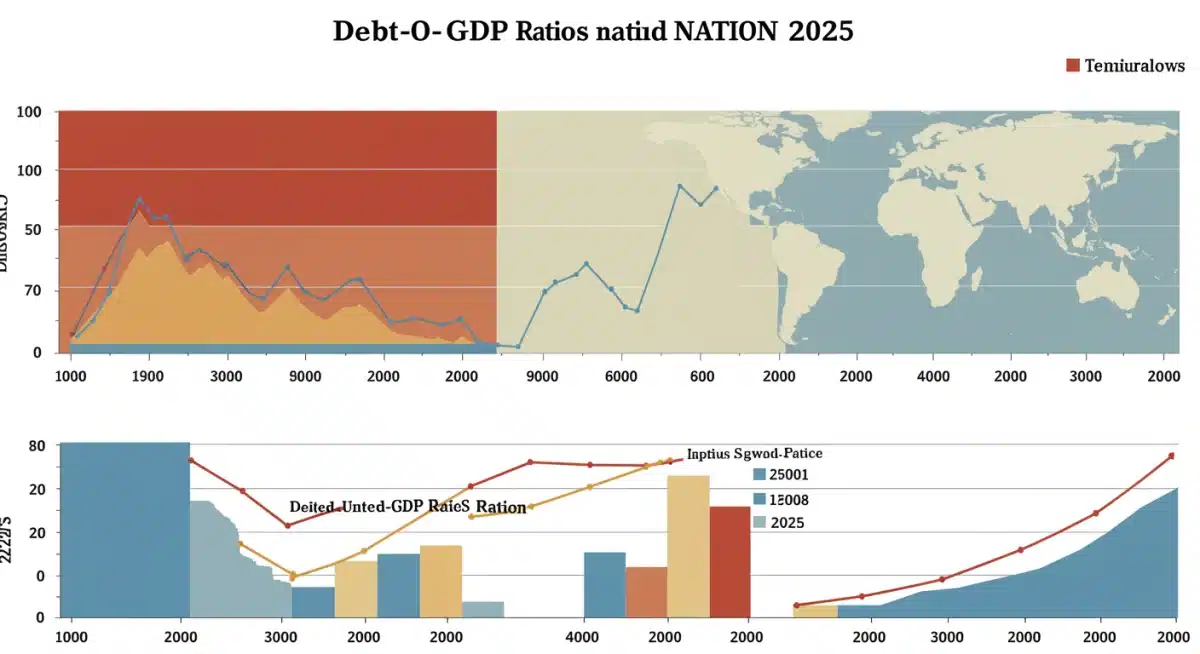
The US Debt-to-GDP Ratio in 2025 carries profound economic implications for the United States, affecting everything from governmental flexibility to the daily lives of its citizens. A high and rising ratio can introduce a range of challenges, potentially constraining future policy options and influencing investor behavior both domestically and internationally. These implications are not merely theoretical; they translate into tangible effects on economic stability and growth.
One of the primary concerns associated with a high Debt-to-GDP ratio is the potential for increased interest rates. As the government borrows more, it may have to offer higher returns to attract lenders, which can, in turn, drive up borrowing costs for businesses and consumers. This can stifle investment, slow economic growth, and make it harder for individuals to afford mortgages and other loans.
potential challenges of a high ratio
A persistently high Debt-to-GDP ratio can lead to several adverse economic outcomes.
- Reduced fiscal space: A larger portion of the federal budget is allocated to debt service, leaving less room for investments in infrastructure, education, or research and development.
- Crowding out effect: Government borrowing can absorb available capital, potentially reducing the funds available for private sector investment.
- Inflationary pressures: In some scenarios, a high debt burden might lead to central banks monetizing debt, which could fuel inflation.
- Loss of investor confidence: If investors perceive the debt as unsustainable, they may demand higher risk premiums, or even reduce their holdings of US Treasury securities.
Furthermore, a high debt burden can limit the government’s ability to respond effectively to future economic crises or unforeseen events. Should another major recession or global pandemic occur, the fiscal tools available to stimulate the economy might be constrained by already elevated debt levels. This reduced flexibility can prolong economic downturns and increase their severity.
In conclusion, the Debt-to-GDP ratio in 2025 is more than just a financial statistic; it’s a barometer of the nation’s economic resilience and future potential. Managing this ratio effectively is crucial for maintaining economic stability, fostering growth, and ensuring the long-term prosperity of the United States.
comparison with global economies
Placing the US Debt-to-GDP Ratio in 2025 within a global context allows for a more nuanced understanding of its implications. While the absolute level of debt is important, comparing it to other major economies reveals how the United States stands relative to its peers. Different countries face unique economic structures, fiscal policies, and demographic challenges, all of which influence their respective debt ratios.
Some developed nations, such as Japan, have significantly higher Debt-to-GDP ratios than the United States, yet they have managed to sustain their economies without immediate crisis. This often comes down to factors like domestic ownership of debt, low interest rates, and a strong export-oriented economy. Conversely, some emerging economies might have lower ratios but face greater vulnerability due to less stable financial systems or reliance on foreign capital.
debt-to-GDP in other developed nations
- Japan: Consistently holds one of the highest Debt-to-GDP ratios globally, largely due to an aging population and prolonged periods of economic stagnation, but much of its debt is held domestically.
- European Union (EU) members: Ratios vary widely, with countries like Greece and Italy historically struggling with high debt, while others like Germany maintain relatively lower levels due to strict fiscal rules.
- China: While its official government debt-to-GDP might appear moderate, concerns exist about hidden debt within local governments and state-owned enterprises, making a direct comparison complex.
The US ratio, while high by historical standards, is generally viewed with relative confidence by international investors due to the dollar’s reserve currency status and the perceived strength and stability of the US economy. However, this confidence is not limitless. A sustained increase without corresponding economic growth could eventually erode this advantage.
Ultimately, the global comparison highlights that while a high Debt-to-GDP ratio is a concern, its impact is mediated by a country’s specific economic characteristics, its ability to service the debt, and the overall confidence of global markets. The US, with its unique position, has more leeway than many, but even that has its limits.
strategies for managing the ratio
Addressing the US Debt-to-GDP Ratio in 2025 requires a multi-faceted approach, combining fiscal discipline with strategies aimed at fostering robust economic growth. There is no single, easy solution, and policymakers often face difficult choices that balance short-term political considerations with long-term economic sustainability. Effective management of the ratio involves both reducing the numerator (debt) and increasing the denominator (GDP).
On the debt reduction side, options typically include expenditure cuts, tax increases, or a combination of both. These measures can be politically unpopular, but they are often necessary to bring fiscal accounts back into balance. On the growth side, policies that encourage investment, innovation, and productivity can help expand the economy, making the existing debt burden more manageable over time.
key strategies and their challenges
Implementing strategies to manage the Debt-to-GDP ratio involves navigating various economic and political hurdles.
- Fiscal consolidation: This involves reducing government spending or increasing taxes. Challenges include potential negative impacts on economic growth in the short term and political resistance.
- Promoting economic growth: Policies such as investments in infrastructure, education, and research and development can boost productivity and GDP. The challenge lies in identifying effective investments and securing funding.
- Monetary policy coordination: The Federal Reserve’s actions on interest rates can influence debt servicing costs. Coordination between fiscal and monetary authorities is crucial.
- Debt restructuring: While typically a last resort for developed nations, exploring options to refinance debt at lower rates or extend maturities can alleviate immediate pressures.
Successful management often requires a long-term vision and bipartisan cooperation. Short-sighted policies that prioritize immediate political gains over fiscal responsibility can exacerbate the problem. Furthermore, global economic conditions and unforeseen events can always disrupt even the best-laid plans, necessitating flexibility and adaptability in policy responses.
In conclusion, managing the US Debt-to-GDP ratio effectively by 2025 and beyond demands a comprehensive strategy that embraces both fiscal prudence and growth-oriented policies. The choices made today will have lasting impacts on the nation’s economic future.
future outlook and policy considerations
The future outlook for the US Debt-to-GDP Ratio in 2025 and beyond remains a topic of intense debate among economists and policymakers. While current projections suggest continued challenges, there are various policy pathways that could alter this trajectory. The decisions made in the coming years regarding fiscal policy, economic stimulus, and structural reforms will be critical in shaping the nation’s financial landscape.
One potential scenario involves a continuation of current trends, with debt growing faster than GDP, leading to an increasing burden on future generations. Another scenario envisions a concerted effort to address the debt, through a combination of spending cuts and revenue enhancements, coupled with policies that ignite robust and sustainable economic growth. The latter, while politically challenging, offers a more optimistic long-term outlook.
critical policy considerations
Several key policy areas will be crucial in determining the future of the Debt-to-GDP ratio.
- Entitlement reform: Adjustments to Social Security and Medicare are often cited as necessary to address long-term fiscal imbalances, given the aging population.
- Tax policy: Debates over tax rates for corporations and high-income earners, as well as consumption taxes, could significantly impact government revenues.
- Investment in productivity: Funding for infrastructure, clean energy, and technological innovation could enhance long-term economic growth, helping to reduce the ratio naturally.
- Budgetary discipline: Implementing stricter controls on discretionary spending and identifying areas for efficiency improvements can contribute to fiscal consolidation.
Moreover, the global economic environment will also play a role. International trade agreements, geopolitical stability, and the performance of other major economies can all influence US growth rates and, consequently, the Debt-to-GDP ratio. Policymakers must continually monitor these external factors and adapt their strategies accordingly.
In conclusion, the future of the US Debt-to-GDP ratio is not predetermined. It will be the result of deliberate policy choices and the nation’s ability to adapt to evolving economic conditions. A proactive and balanced approach, focusing on both fiscal responsibility and growth-enhancing measures, offers the best path toward a stable and prosperous economic future.
| Key Aspect | Brief Description |
|---|---|
| Ratio Definition | Measures national debt against Gross Domestic Product, indicating fiscal health. |
| 2025 Outlook | Projected continued increase due to spending, demographics, and interest rates. |
| Economic Impact | Potential for higher interest rates, reduced fiscal flexibility, and investor concern. |
| Management Strategies | Fiscal consolidation, growth promotion, and entitlement reforms are key. |
frequently asked questions about debt-to-GDP
A high Debt-to-GDP ratio primarily raises concerns about a nation’s ability to service its debt, potentially leading to increased borrowing costs, inflationary pressures, and reduced fiscal flexibility for future economic challenges or investments.
While the US ratio is high by historical standards, its global standing varies. Some developed nations, like Japan, have higher ratios, often mitigated by factors such as domestic debt ownership and strong economic fundamentals. The US dollar’s reserve currency status also provides some unique advantages.
Key contributors include sustained federal budget deficits from tax cuts and increased spending, an aging population leading to higher entitlement costs (Social Security, Medicare), and rising interest rates that increase debt servicing expenses.
While robust economic growth can help lower the ratio by increasing GDP, it’s rarely a standalone solution. Sustainable management typically requires a combination of growth-enhancing policies and fiscal discipline, such as controlled spending or revenue adjustments.
Unmanaged high ratios can lead to a cycle of increasing debt servicing costs, reduced public investment, slower economic growth, and potentially a loss of international investor confidence, impacting the nation’s long-term prosperity and global influence.
conclusion
The US Debt-to-GDP Ratio in 2025 presents a complex and critical challenge for the United States. As explored, its trajectory is shaped by a confluence of historical trends, current fiscal policies, and future economic dynamics. Understanding this ratio is not merely an academic exercise; it provides essential insights into the nation’s financial health, its capacity for future investment, and its standing in the global economy. Effective management requires a balanced approach, combining prudent fiscal measures with strategies to foster sustainable economic growth. The decisions made by policymakers in the coming years will undoubtedly have far-reaching implications, influencing everything from interest rates and inflation to job creation and social programs. Navigating these challenges successfully will be paramount to ensuring the continued economic stability and prosperity of the United States.