SSI vs. SSDI 2026: A Detailed Comparison of Federal Disability Programs and Which One Offers More Benefits for Your Situation
Anúncios
Understanding the landscape of federal disability benefits can be a daunting task, especially when faced with acronyms like SSI and SSDI. These two programs, while both administered by the Social Security Administration (SSA) and designed to provide financial assistance to individuals with disabilities, operate under fundamentally different rules and serve distinct populations. As we look towards 2026, it’s crucial for applicants to grasp these nuances to determine which program, if any, aligns with their specific circumstances and offers the most beneficial support.
This comprehensive guide will delve deep into the intricacies of SSI vs. SSDI, providing a detailed comparison that covers eligibility requirements, benefit structures, application processes, and potential overlaps. Our goal is to demystify these programs, equipping you with the knowledge needed to navigate the system effectively and secure the assistance you deserve. Whether you’re just starting your research or are in the midst of an application, understanding the core differences between SSI and SSDI is your first critical step.
Anúncios
What is SSI (Supplemental Security Income)?
Supplemental Security Income (SSI) is a federal program that provides monthly financial assistance to adults and children with disabilities or blindness who have limited income and resources. It also provides benefits to people 65 and older without disabilities who meet the financial limits. Unlike Social Security Disability Insurance (SSDI), SSI is not based on your work history or the Social Security taxes you’ve paid. Instead, it’s a needs-based program, meaning eligibility is primarily determined by your financial situation.
SSI Eligibility Requirements for 2026
To qualify for SSI in 2026, applicants must meet several stringent criteria:
Anúncios
- Disability or Blindness: You must meet the SSA’s definition of disability, which generally means you cannot engage in any substantial gainful activity (SGA) due to a medically determinable physical or mental impairment that is expected to result in death or has lasted or is expected to last for a continuous period of not less than 12 months. For children, the disability standard is slightly different, focusing on functional limitations.
- Age: Be age 65 or older, or be blind, or have a qualifying disability.
- Limited Income: Your countable income must be below a certain federal limit, which changes annually. The SSA considers most types of income, including wages, pensions, and even in-kind support (like free rent or food). However, many types of income are excluded or partially excluded from this calculation.
- Limited Resources: Your countable resources (assets) must not exceed a specified limit. For an individual, this limit is typically $2,000, and for a couple, it’s $3,000. Resources include cash, bank accounts, stocks, and other assets that can be converted to cash. Certain assets, such as your primary residence, one vehicle, and household goods, are usually excluded.
- Citizenship/Residency: You must be a U.S. citizen or national, or in certain categories of aliens who are lawfully present in the U.S.
SSI Benefits and Healthcare Coverage
The maximum federal SSI benefit amount also changes annually. In addition to the federal benefit, many states supplement the federal SSI payment with their own funds, meaning the total monthly payment can vary significantly by state. Receiving SSI benefits often automatically qualifies you for Medicaid in most states, providing crucial healthcare coverage. This can be a significant advantage for individuals who lack other forms of health insurance.
What is SSDI (Social Security Disability Insurance)?
Social Security Disability Insurance (SSDI) is a federal insurance program that pays benefits to you and certain members of your family if you are ‘insured’ – meaning you worked long enough and paid Social Security taxes. It is not a needs-based program like SSI; rather, it’s an earned benefit. Your eligibility and the amount of your monthly benefit are tied directly to your past earnings record.
SSDI Eligibility Requirements for 2026
To qualify for SSDI in 2026, you generally need to meet two primary criteria:
- Disability Definition: You must meet the SSA’s strict definition of disability, which is the same as for SSI – an inability to engage in any substantial gainful activity (SGA) due to a severe medical condition that has lasted or is expected to last for at least 12 months or result in death.
- Work Credits: You must have accumulated a sufficient number of ‘work credits’ through your employment. Work credits are earned by paying Social Security taxes on your earnings. The number of credits required depends on your age when your disability began. Generally, you need 40 credits, 20 of which must have been earned in the last 10 years ending with the year you became disabled. Younger workers may qualify with fewer credits. The SSA determines how many credits you earn based on your total annual wages or self-employment income.
SSDI Benefits and Healthcare Coverage
SSDI benefits are calculated based on your average lifetime earnings covered by Social Security. This means that individuals who earned more over their working lives will generally receive higher monthly SSDI payments. There is no federal maximum benefit for SSDI that is tied to income or resources, unlike SSI. After receiving SSDI benefits for 24 months, you become eligible for Medicare, regardless of your age. This two-year waiting period for Medicare is an important consideration for many applicants.
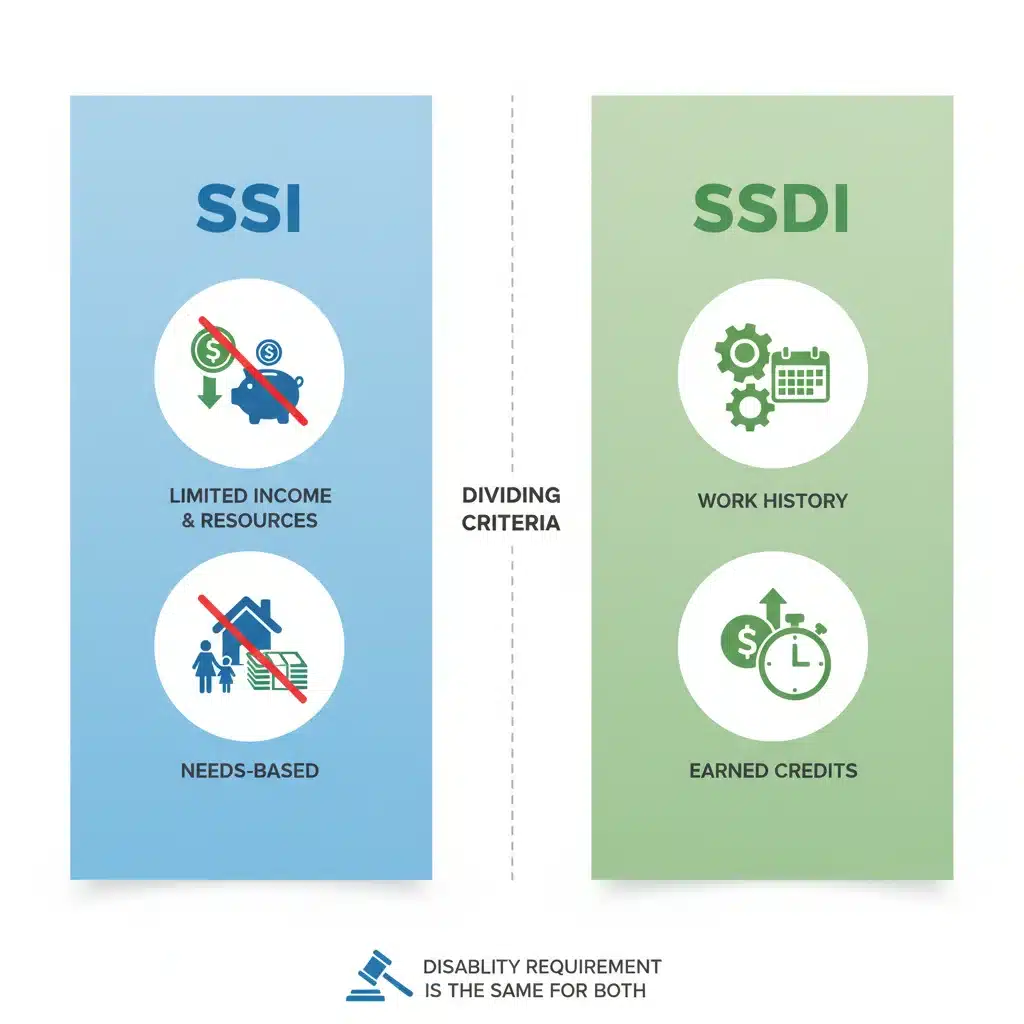
SSI vs. SSDI 2026: Key Differences at a Glance
To help clarify the distinctions, here’s a side-by-side comparison of the core elements of SSI vs. SSDI for 2026:
| Feature | SSI (Supplemental Security Income) | SSDI (Social Security Disability Insurance) |
|---|---|---|
| Funding Source | General tax revenues | Social Security taxes (FICA) |
| Eligibility Basis | Needs-based (limited income & resources) | Work history & earned work credits |
| Work Credits Required | None | Yes, based on age at disability onset |
| Disability Definition | Same strict SSA definition for both | Same strict SSA definition for both |
| Benefit Amount | Varies by federal maximum & state supplements; not tied to earnings | Based on average lifetime earnings (APE); generally higher for higher earners |
| Healthcare Coverage | Typically Medicaid (automatic in most states) | Medicare (after a 24-month waiting period) |
| Dependents’ Benefits | Generally no dependent benefits | Yes, for eligible spouses & children |
| Age Requirement | 65+, blind, or disabled (no work history needed) | Any age (if work credits are met) |
| Resource Limit | Yes ($2,000 individual, $3,000 couple) | No resource limit |
| Income Limit | Yes (countable income below federal benefit rate) | No income limit (only Substantial Gainful Activity (SGA) limit) |
Determining Which Program is Right for You
Deciding between SSI and SSDI (or if you qualify for both) hinges on your personal circumstances. Consider the following questions:
- Have you worked consistently and paid Social Security taxes? If yes, SSDI is likely your primary consideration. The more you’ve worked and earned, the higher your potential SSDI benefit.
- Do you have limited income and few assets? If your financial resources are scarce, SSI becomes a crucial program to explore, even if you have some work history.
- What are your healthcare needs? Immediate access to Medicaid through SSI might be vital for some, while others might be able to wait the 24 months for Medicare through SSDI.
- Do you have dependents? If you have a spouse or minor children who rely on your income, SSDI offers auxiliary benefits that SSI does not.
It’s important to note that it is possible to qualify for both SSI and SSDI simultaneously. This is known as receiving ‘concurrent benefits.’ This typically occurs when an individual qualifies for SSDI, but their SSDI benefit amount is very low, falling below the federal SSI benefit rate. In such cases, SSI can supplement the SSDI payment to bring the total up to the SSI maximum, and often provides immediate Medicaid eligibility.
The Application Process for SSI and SSDI in 2026
The application process for both SSI and SSDI is largely similar, as the SSA uses the same medical disability criteria for both programs. However, the financial and work history reviews differ significantly.
Steps in the Application Process:
- Gather Information: Collect all necessary documents, including medical records, work history, financial statements, and personal identification.
- Apply Online, By Phone, or In-Person: You can start your application for SSDI online. For SSI, you can start online but will likely need to complete an interview. You can also apply for both by calling the SSA or visiting a local office.
- Medical Review: The SSA will send your application to a state agency, Disability Determination Services (DDS), which will evaluate your medical condition to determine if you meet the definition of disability. They may request additional medical records or schedule a consultative examination (CE).
- Non-Medical Review: For SSDI, the SSA reviews your work history to ensure you have enough work credits. For SSI, they conduct a thorough review of your income and resources.
- Decision: You will receive a decision letter by mail. If approved, it will detail your benefit amount and when payments will begin. If denied, it will explain the reasons and your appeal rights.
Tips for a Successful Application:
- Be Thorough with Medical Evidence: This is the cornerstone of your disability claim. Provide complete and up-to-date medical records, including diagnoses, treatment plans, medication lists, and doctors’ notes.
- Be Honest and Detailed: Provide accurate information about your daily limitations, pain levels, and how your condition affects your ability to perform work-related activities.
- Seek Professional Help: Consider consulting with a disability attorney or advocate. They can help you gather evidence, understand the process, and represent you during appeals. Statistics show that applicants represented by an attorney have a higher success rate.
- Don’t Give Up After a Denial: Many initial applications are denied. The appeals process has several stages, and it’s common to be approved at a later stage, such as a hearing with an Administrative Law Judge (ALJ).

Potential Challenges and Considerations for 2026
While both SSI and SSDI provide vital support, applicants and beneficiaries should be aware of several potential challenges and considerations:
- Strict Definition of Disability: The SSA’s definition of disability is very strict. It’s not enough to have a medical condition; you must demonstrate that it prevents you from doing any substantial work.
- Long Waiting Periods: The application and review process can be lengthy, often taking several months to over a year. For SSDI, there’s also a five-month waiting period for benefits to begin after your disability onset date, and a 24-month waiting period for Medicare eligibility.
- Continuing Disability Reviews (CDRs): Both SSI and SSDI beneficiaries are subject to periodic CDRs to ensure they still meet the SSA’s definition of disability.
- Impact on Other Benefits: Receiving SSI or SSDI can affect eligibility for other federal or state benefits, so it’s important to understand the overall financial picture.
- Changes and Updates in 2026: While the core structures of SSI and SSDI are relatively stable, benefit amounts, income/resource limits for SSI, and work credit requirements for SSDI are subject to annual adjustments. Staying informed about these potential changes for 2026 is crucial.
Understanding Substantial Gainful Activity (SGA)
A critical concept for both SSI and SSDI is Substantial Gainful Activity (SGA). The SSA defines SGA as work activity that involves doing significant physical or mental activities for pay or profit. If you are engaging in SGA, you are generally not considered disabled by the SSA. The monthly SGA amount is updated annually. For 2026, this amount will likely see an increase from previous years. It’s vital to understand this limit, as exceeding it, even for part-time work, can jeopardize your disability benefits.
Working While Receiving Benefits: Work Incentives
The SSA offers various ‘work incentives’ designed to help people with disabilities return to work without immediately losing their benefits. These include:
- Trial Work Period (TWP) for SSDI: Allows beneficiaries to test their ability to work for up to nine months without affecting their SSDI benefits, regardless of earnings.
- Extended Period of Eligibility (EPE) for SSDI: After the TWP, if you continue to work above the SGA limit, you can still receive benefits for any month your earnings fall below SGA for 36 months.
- Impairment-Related Work Expenses (IRWE): Certain expenses related to your disability that are necessary for you to work can be deducted from your earnings when calculating SGA for both SSI and SSDI.
- Plan to Achieve Self-Support (PASS) for SSI: Allows individuals to set aside income and resources for a work goal, such as education or starting a business, without those funds counting against their SSI eligibility.
These work incentives are complex, and it’s highly recommended to consult with the SSA or a benefits specialist to understand how they apply to your specific situation and to ensure you maximize your opportunities without jeopardizing your benefits.
Concurrent Benefits: Receiving Both SSI and SSDI
As mentioned, it’s possible to receive both SSI and SSDI benefits simultaneously, known as concurrent benefits. This usually happens when an individual has worked enough to qualify for SSDI, but their Primary Insurance Amount (PIA) – the basis for their SSDI benefit – is low. If the SSDI benefit is below the federal SSI maximum benefit amount for 2026, SSI can supplement the SSDI payment. This scenario is particularly beneficial because it often provides immediate access to Medicaid (through SSI) and eventual Medicare (through SSDI), offering a robust safety net for healthcare needs. Navigating concurrent benefits requires careful attention to reporting income and resources to the SSA, as changes in one benefit can affect the other.
The Role of State Programs and Other Assistance
Beyond federal SSI and SSDI, many states offer additional programs and assistance for individuals with disabilities. These can include state-funded cash assistance, housing subsidies, food assistance programs (like SNAP), and vocational rehabilitation services. It’s essential to research what resources are available in your specific state or locality, as these can significantly enhance the support provided by federal disability benefits. When considering SSI vs. SSDI, remember that state supplements to SSI can make a substantial difference in the overall financial support received.
Future Outlook: SSI vs. SSDI in 2026 and Beyond
While the fundamental structures of SSI and SSDI are expected to remain consistent in 2026, there are ongoing discussions and potential legislative changes that could impact these programs in the future. These often revolve around funding, benefit levels, and administrative processes. Staying informed through official Social Security Administration channels and reputable disability advocacy groups will be important for beneficiaries and applicants alike. The goal of both programs remains to provide a financial safety net, but adapting to potential policy shifts is a continuous necessity.
Conclusion: Making an Informed Decision for Your Future
The decision of whether to apply for SSI, SSDI, or both, is a highly personal one, dependent on a multitude of factors including your work history, current financial situation, medical condition, and future needs. The critical takeaway from this SSI vs. SSDI comparison is that these are distinct programs with different eligibility criteria and benefit structures. Understanding these differences is paramount to a successful application and securing the appropriate support.
Don’t hesitate to utilize the resources available to you. The Social Security Administration’s website (SSA.gov) is an invaluable source of information. Additionally, consulting with a disability attorney, advocate, or financial advisor specializing in disability benefits can provide personalized guidance tailored to your unique circumstances. By taking the time to thoroughly understand SSI vs. SSDI in 2026, you can empower yourself to make the best decision for your health, financial stability, and overall well-being.