Remote Learning Advantages: US Adult Education 2026

Anúncios
The educational landscape is in perpetual motion, constantly adapting to technological advancements, societal shifts, and the evolving needs of learners. Nowhere is this transformation more evident than in adult education. For years, traditional classroom settings dominated, but the advent of digital technologies has ushered in a new era, with remote learning at its forefront. As we look towards 2026 and beyond, the shift to remote learning for US adult education is not just a trend; it’s a fundamental redefinition of how adults acquire knowledge, develop skills, and advance their careers. This comprehensive article will delve into the four pivotal advantages that make remote learning an indispensable component of future adult education strategies: unparalleled flexibility, enhanced accessibility, significant cost-effectiveness, and truly personalized learning experiences.
Anúncios
The demand for lifelong learning has never been higher. In a rapidly changing job market, adults are increasingly seeking opportunities to reskill, upskill, and adapt to new industry demands. Traditional educational models often present significant barriers for these learners, including time constraints due to work and family commitments, geographical limitations, and the financial burden of tuition and associated costs. Remote learning, powered by robust online platforms and innovative pedagogical approaches, directly addresses these challenges, offering a viable and often superior alternative.
Let’s explore each of these advantages in detail, understanding how they contribute to a more inclusive, efficient, and effective adult education system in the United States.
Anúncios
1. Unparalleled Flexibility: Reshaping the Adult Learner’s Schedule
One of the most compelling arguments for the widespread adoption of remote learning in US adult education is the sheer flexibility it offers. Adult learners often juggle multiple responsibilities, including full-time jobs, family care, and community engagements. Traditional in-person courses, with their fixed schedules and locations, can be incredibly difficult to fit into such busy lives. Remote learning, however, untethers education from these constraints, providing a level of adaptability that is revolutionizing how adults learn.
Asynchronous vs. Synchronous Learning: Remote learning encompasses both asynchronous and synchronous modes. Asynchronous learning allows students to access course materials, lectures, and assignments at any time that suits them, within specified deadlines. This means a parent can complete coursework after their children are asleep, or a shift worker can study during their off-hours. Synchronous remote learning involves live online sessions, but even these typically offer recordings for those who cannot attend in real-time, further enhancing flexibility.
Self-Paced Progress: Many remote learning programs are designed to be self-paced, allowing adult learners to accelerate through familiar material or spend more time on challenging concepts. This individualized approach respects the diverse prior knowledge and learning speeds of adults, preventing boredom for some and reducing anxiety for others. This self-direction empowers learners, fostering a greater sense of ownership over their educational journey.
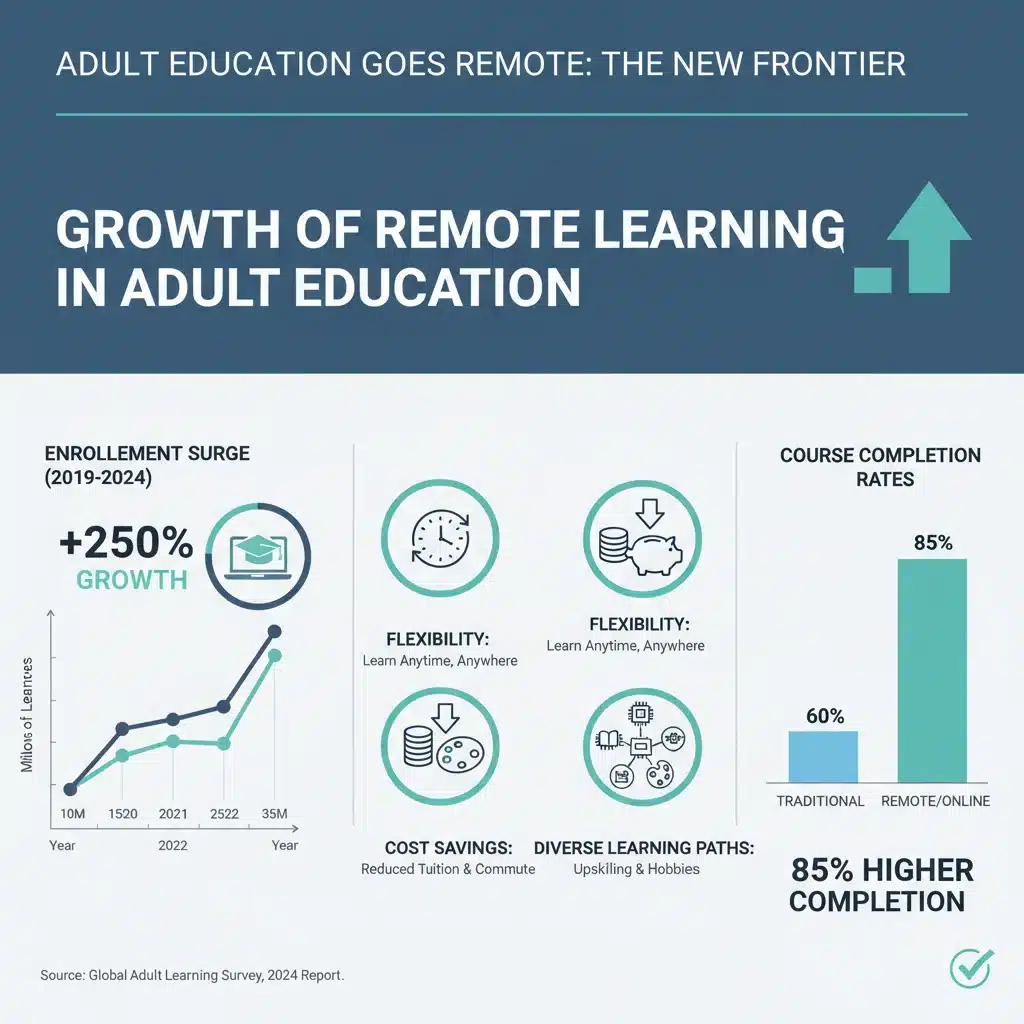
Location Independence: The ability to learn from anywhere with an internet connection is a game-changer. Whether an adult learner is commuting, traveling for work, or simply prefers the comfort of their home, remote learning makes it possible. This eliminates the need for daily commutes, saving time, money, and reducing stress. It also opens up educational opportunities to individuals in rural areas or those with mobility challenges who might otherwise be excluded from traditional programs.
Balancing Work and Study: For many adults, continuing education is directly linked to career advancement. Remote learning enables them to pursue further qualifications without having to put their careers on hold. They can apply new knowledge and skills directly to their current roles, creating a symbiotic relationship between learning and professional growth. This integration of learning into daily life is crucial for fostering a culture of continuous improvement in the workforce.
The flexibility inherent in remote learning is not merely a convenience; it is a fundamental enabler for millions of adults who aspire to higher education or professional development but face significant logistical hurdles. By removing these barriers, remote learning democratizes access to knowledge and empowers individuals to pursue their educational goals on their own terms.
2. Enhanced Accessibility: Breaking Down Geographical and Physical Barriers
Beyond flexibility, enhanced accessibility stands as a cornerstone advantage of remote learning for US adult education. Traditional educational institutions, by their very nature, are bound by physical locations. This creates significant barriers for individuals who live in remote areas, those with disabilities, or those who simply do not have a local institution offering the specific program they need. Remote learning fundamentally dismantles these barriers, creating a more inclusive educational ecosystem.
Geographical Reach: With remote learning, the ‘classroom’ is no longer limited to a physical building. An adult in a rural town in Montana can access a specialized program offered by a university in New York. This geographical liberation means that learners are no longer restricted by where they live, but rather by their access to an internet connection. This vastly expands the pool of potential students and allows institutions to reach a much broader audience.
Inclusivity for Individuals with Disabilities: Remote learning platforms often incorporate features that make education more accessible for individuals with disabilities. Screen readers, captioning for videos, adjustable font sizes, and alternative input methods are standard in well-designed online courses. This contrasts sharply with many physical classrooms that may lack necessary accommodations, making remote learning a more equitable option for many.
Overcoming Transportation Issues: For many adults, reliable transportation to and from a campus can be a major hurdle. This includes those without personal vehicles, those relying on public transport with limited routes, or individuals living in areas with poor infrastructure. Remote learning eliminates this concern entirely, as the ‘commute’ is simply logging onto a computer or device.
Access to Specialized Programs: Niche fields and highly specialized subjects may only be offered at a limited number of institutions. For an adult learner seeking expertise in a very specific area, traveling across the country for a degree or certification is often impractical. Remote learning bridges this gap, allowing individuals to pursue highly specialized knowledge from anywhere, connecting them with expert instructors and unique curricula they might otherwise never encounter.
Global Perspectives: Increased accessibility also means that adult learners are exposed to a more diverse cohort of peers and instructors from different geographical and cultural backgrounds. This enriches the learning experience, fostering a broader understanding of global issues and different perspectives, which is invaluable in today’s interconnected world. The ability to collaborate with individuals from various regions, even internationally, enhances the depth and breadth of the educational journey.
The expansion of accessibility through remote learning ensures that educational opportunities are no longer a privilege dictated by location or physical ability, but a fundamental right available to all who seek it. This is a powerful driver for social mobility and economic development across the nation.
3. Significant Cost-Effectiveness: Making Education More Affordable
The financial burden of education is a significant concern for many adult learners. Tuition fees, textbooks, transportation, childcare, and potential loss of income from reduced work hours can quickly accumulate, making higher education seem out of reach. Remote learning offers a compelling solution by significantly reducing many of these associated costs, thereby making education more attainable for a wider demographic.
Reduced Tuition and Fees: While not universally true, many online programs, particularly those from community colleges or state universities, often have lower tuition rates than their on-campus equivalents. Even when tuition is comparable, the elimination of various campus-specific fees (e.g., student activity fees, athletic fees, parking permits) can lead to substantial savings. Furthermore, the ability to study part-time through remote learning means that students can spread the cost of their education over a longer period, making it more manageable.
Elimination of Commuting Costs: As mentioned earlier, remote learning negates the need for daily commutes. This translates into direct savings on gasoline, public transportation fares, vehicle maintenance, and parking fees. For an adult learner commuting several times a week, these savings can amount to hundreds, if not thousands, of dollars annually.
Lower Living Expenses: For students who might otherwise need to relocate to attend a particular institution, remote learning eliminates the need for moving expenses, higher rent in university towns, and increased utility costs. This allows adults to remain in their current living situations, minimizing disruption and financial strain.
Flexible Work Schedules and Income Retention: One of the biggest financial advantages for adult learners is the ability to maintain their employment while studying. Traditional programs often require significant time commitments during working hours, forcing students to reduce their work hours or even quit their jobs. Remote learning, especially asynchronous options, allows individuals to schedule their studies around their work, ensuring a steady income stream and preventing financial hardship.
Reduced Ancillary Costs: Beyond the major expenses, remote learning also reduces numerous smaller, yet impactful, costs. These can include money spent on campus dining, professional attire for classes, and even the cost of physical textbooks, as many online courses utilize digital resources or open educational materials. The cumulative effect of these small savings can be quite significant.
By making education more financially accessible, remote learning empowers more adults to invest in their future without incurring crippling debt or sacrificing their current financial stability. This cost-effectiveness is a critical factor in fostering a more educated and skilled workforce across the US.
4. Personalized Learning Experiences: Tailoring Education to Individual Needs
The one-size-fits-all model of traditional education often struggles to cater to the diverse learning styles, paces, and prior experiences of adult learners. Remote learning, however, is uniquely positioned to offer highly personalized learning experiences, adapting to individual needs and maximizing engagement and retention. This is perhaps one of the most powerful and transformative advantages for adult education in the coming years.
Adaptive Learning Technologies: Many remote learning platforms leverage artificial intelligence and machine learning to offer adaptive learning paths. These systems can assess a learner’s strengths and weaknesses, then tailor content, exercises, and assessments to their specific needs. If a student masters a concept quickly, the system can move them ahead; if they struggle, it can provide additional resources and practice, ensuring no one is left behind or held back.
Variety of Learning Resources: Online environments allow for a rich tapestry of learning resources. Instead of relying solely on lectures and textbooks, remote courses can integrate videos, interactive simulations, virtual labs, podcasts, discussion forums, and external web resources. This multi-modal approach caters to different learning preferences, whether visual, auditory, kinesthetic, or reading/writing based.
Self-Paced and Self-Directed Learning: While touched upon under flexibility, the self-paced nature of much of remote learning directly contributes to personalization. Adult learners can spend more time on topics they find challenging and less on those they already understand. This autonomy fosters deeper engagement and allows learners to take ownership of their educational journey, leading to better outcomes.
Immediate Feedback and Progress Tracking: Digital platforms often provide immediate feedback on quizzes and assignments, allowing learners to correct misunderstandings in real-time. Detailed analytics and progress tracking tools enable both students and instructors to monitor performance, identify areas for improvement, and adjust learning strategies accordingly. This continuous feedback loop is crucial for effective adult learning.
Focus on Individual Goals: Adult learners often have very specific goals for their education, whether it’s a career change, skill upgrade, or personal enrichment. Remote learning programs can be designed with modular components, micro-credentials, and stackable courses, allowing individuals to curate a learning path that directly aligns with their unique aspirations. This targeted approach ensures that every educational effort is relevant and impactful.
The ability to personalize the learning experience transforms education from a passive reception of information into an active, engaging, and highly effective process. This deeply individualized approach ensures that adult education remote learning is not just about delivering content, but about facilitating genuine understanding and skill acquisition tailored to each learner’s potential.

Challenges and Future Outlook for Adult Education Remote Learning
While the advantages of adult education remote learning are clear and compelling, it’s also important to acknowledge potential challenges. Issues such as the digital divide (lack of reliable internet access or devices), the need for robust self-discipline, and the importance of fostering a sense of community among online learners are areas that require continuous attention and innovative solutions. However, these challenges are increasingly being addressed by policymakers, educational institutions, and technology providers.
In 2026 and beyond, we can expect to see further advancements in remote learning technologies. Virtual reality (VR) and augmented reality (AR) are poised to create even more immersive and interactive learning environments. AI-powered tutors will become more sophisticated, offering even more personalized support. The integration of gamification will make learning more engaging, and the development of open educational resources will continue to drive down costs.
Furthermore, the hybrid model, blending the best aspects of remote and in-person learning, is likely to become more prevalent. This approach offers adults the flexibility of online learning while retaining opportunities for face-to-face interaction, networking, and hands-on experiences when necessary. The key will be to design these hybrid models thoughtfully, ensuring seamless transitions and integrated learning pathways.
The focus will increasingly be on competency-based education, where learners advance upon demonstrating mastery of skills, rather than simply completing seat time. Remote learning platforms are particularly well-suited for this approach, allowing for continuous assessment and personalized progression. This shift will make adult education even more relevant to workforce needs, as employers are primarily interested in what individuals can do, not just where they studied.
Moreover, the role of micro-credentials and digital badges will continue to grow. These smaller, stackable qualifications allow adults to gain specific skills quickly and demonstrate them to employers, without committing to a full degree program. Remote learning is the ideal delivery mechanism for these agile and responsive educational offerings, enabling rapid upskilling and reskilling in response to market demands.
Conclusion: The Enduring Impact of Remote Learning on US Adult Education
The shift to remote learning represents a monumental transformation in US adult education, one that is here to stay and will only continue to evolve. The four key advantages—unparalleled flexibility, enhanced accessibility, significant cost-effectiveness, and truly personalized learning experiences—are not merely incremental improvements; they are foundational pillars for a more equitable, efficient, and effective educational future. By embracing these benefits, adult education institutions can better serve the diverse needs of learners, empower individuals to achieve their full potential, and contribute to a more skilled and adaptable workforce.
As technology advances and pedagogical approaches mature, remote learning will continue to break down barriers, making education a continuous, integrated part of adult life. The future of US adult education in 2026 and beyond is undeniably digital, flexible, accessible, affordable, and deeply personal, thanks to the transformative power of remote learning. It is an exciting time for lifelong learners, as the path to knowledge and skill development becomes more open and tailored than ever before. Investing in robust remote learning infrastructure and innovative instructional design will be paramount for institutions aiming to thrive in this new educational paradigm and truly serve the needs of the modern adult learner.
The ongoing evolution of adult education remote learning promises a future where learning is not a one-time event but a continuous journey, available to anyone, anywhere, at any time. This paradigm shift will not only benefit individual learners but also foster a more resilient, innovative, and prosperous society as a whole.