PSLF 2025: Meeting the 120 Payment Requirement for Loan Forgiveness
Anúncios
The 2025 Public Service Loan Forgiveness (PSLF) program offers a pathway to debt relief for eligible public service workers who meet the 120 qualifying payment requirement, providing significant financial benefits.
Anúncios
Understanding the 2025 Public Service Loan Forgiveness (PSLF) Program: Meeting the 120 Payment Requirement is a critical step for public service professionals aiming for student loan relief. This program offers a lifeline, but navigating its specific criteria, especially the 120 qualifying payments, can be complex.
The Fundamentals of PSLF: What You Need to Know
The Public Service Loan Forgiveness (PSLF) program is designed to encourage individuals to enter and remain in full-time public service employment. It provides a path to forgiveness for the remaining balance on federal direct loans after 120 qualifying monthly payments have been made under a qualifying repayment plan while working for a qualifying employer. Understanding these foundational elements is crucial for anyone considering PSLF as a debt relief strategy.
Anúncios
The program has evolved significantly since its inception, with recent changes aiming to simplify the process and expand eligibility. For those looking towards 2025 and beyond, staying informed about the current rules and any forthcoming adjustments is paramount to successfully achieving loan forgiveness.
Eligible employment and loan types
To qualify for PSLF, your employment must be with a U.S. federal, state, local, or tribal government organization, or a not-for-profit organization that is tax-exempt under Section 501(c)(3) of the Internal Revenue Code. This includes a wide range of professions, from teachers and nurses to public defenders and military personnel.
- Government organizations: Any level of government (federal, state, local, tribal).
- 501(c)(3) non-profits: Most non-profit organizations that are tax-exempt.
- Other non-profits: Certain other non-profit organizations that provide specific public services.
Only federal direct loans are eligible for PSLF. If you have Federal Family Education Loan (FFEL) Program loans or Perkins Loans, you may need to consolidate them into a Direct Consolidation Loan to make them eligible. This consolidation must happen before you begin making qualifying payments for PSLF purposes.
In essence, PSLF rewards dedication to public service by alleviating the burden of student loan debt. By meeting the employment and loan type criteria, borrowers set the stage for pursuing the 120 qualifying payments necessary for forgiveness.
Deciphering the 120 Qualifying Payments
The core of the PSLF program revolves around making 120 qualifying monthly payments. This is not simply 120 payments; each payment must meet specific criteria to count towards forgiveness. Misunderstanding these requirements is a common pitfall that can delay or even prevent loan forgiveness.
A qualifying payment is one made after October 1, 2007, under a qualifying repayment plan, for the full amount due as shown on your bill, no later than 15 days after your due date, while you are employed full-time by a qualifying employer. These payments do not need to be consecutive, allowing for periods of non-qualifying employment or breaks in payments, though these periods will not count towards the 120 total.
Qualifying repayment plans
One of the most critical aspects of meeting the 120 payment requirement is being enrolled in a qualifying repayment plan. Generally, these are income-driven repayment (IDR) plans, which calculate your monthly payment based on your income and family size. Standard repayment plans also qualify, but they typically repay the loan in 10 years, meaning there would be no balance left to forgive at the 120-payment mark.
- Income-Driven Repayment (IDR) plans: These include Revised Pay As You Earn (REPAYE), Pay As You Earn (PAYE), Income-Based Repayment (IBR), and Income-Contingent Repayment (ICR).
- Standard Repayment Plan: While technically qualifying, it usually results in full repayment before 120 payments are made.
It’s vital to ensure you are on the correct repayment plan. Many borrowers unknowingly make payments under non-qualifying plans, only to find out later that those payments do not count. Regularly checking your loan servicer’s records and submitting the PSLF Employment Certification Form (ECF) annually can help prevent such issues.
Understanding the nuances of qualifying payments is fundamental. Each payment brings you closer to forgiveness, provided it adheres to the program’s strict guidelines regarding timing, amount, and repayment plan. Diligence in tracking these payments is key to success.
The Importance of Full-Time Qualifying Employment
Beyond making the correct payments, maintaining full-time employment with a qualifying employer is the other cornerstone of the PSLF program. This requirement is often misunderstood, leading to confusion and potential setbacks for borrowers. For 2025, the definitions remain largely consistent, emphasizing consistency and adherence to specific criteria.
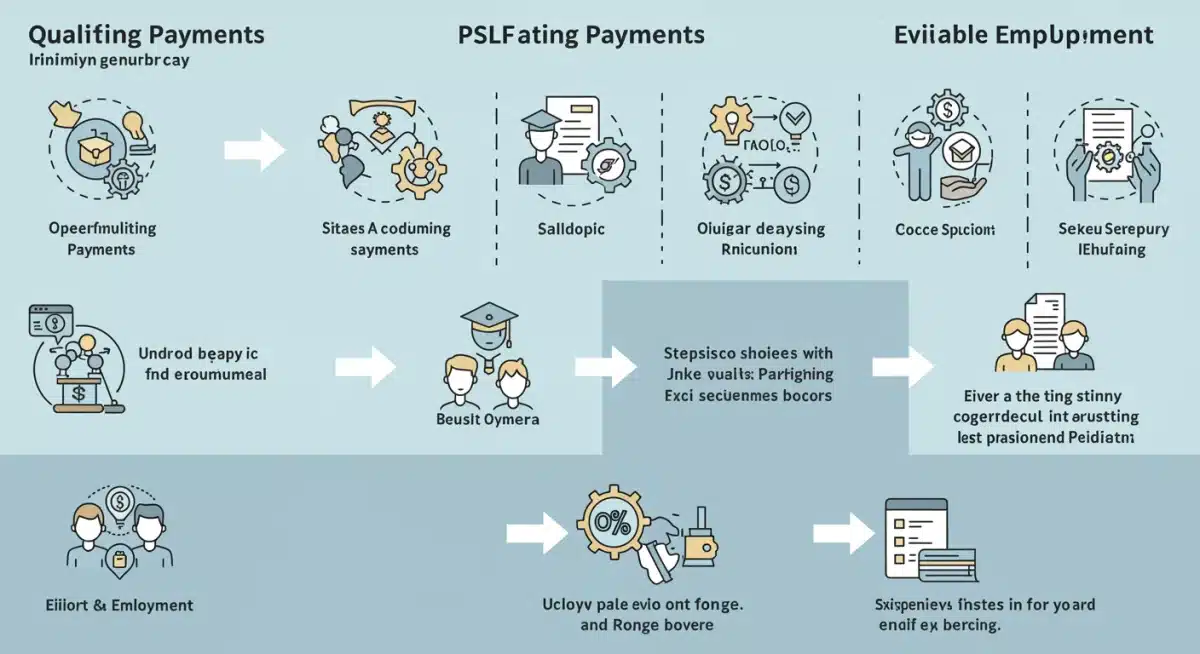
Full-time employment for PSLF purposes generally means working at least 30 hours per week for one or more qualifying employers. If you work for multiple qualifying employers, the hours can be combined to meet the 30-hour minimum. This flexibility is beneficial for those who might hold part-time positions across different public service organizations.

What counts as full-time?
The definition of full-time can sometimes be tricky, especially for adjunct faculty or those with fluctuating hours. It’s important to clarify this with your employer and, if necessary, with your loan servicer. The Department of Education provides specific guidance, and generally, any period of employment where you meet the 30-hour threshold counts. However, some contractual arrangements might require careful review.
- Single employer: At least 30 hours per week.
- Multiple employers: Combined hours must total at least 30 per week, provided all employers are qualifying.
- Contractual vs. regular employment: Both can qualify, but documentation is key.
Crucially, you must be employed full-time by a qualifying employer at the time you make each of your 120 qualifying payments and also at the time you apply for and receive forgiveness. A lapse in qualifying employment, even if temporary, means any payments made during that lapse will not count. This highlights the need for continuous qualifying employment throughout the 10-year repayment period.
Ensuring your employment consistently meets PSLF criteria is as important as making qualifying payments. Regular submission of the Employment Certification Form is the best way to track and confirm your progress, providing peace of mind and preventing potential issues down the line.
The PSLF Employment Certification Form (ECF): Your Annual Check-in
The PSLF Employment Certification Form (ECF) is arguably one of the most critical documents in the PSLF journey. It serves as your official record of qualifying employment and payments, allowing the Department of Education to track your progress towards the 120 payments. Submitting this form regularly, ideally annually or whenever you change employers, is not just recommended; it’s essential.
The ECF allows the Department of Education to confirm that your employer is a qualifying organization and that you are working full-time. Once processed, you will receive a letter detailing how many qualifying payments you have made. This ongoing feedback is invaluable for ensuring you remain on track and can identify any discrepancies early on.
Benefits of regular ECF submission
Submitting the ECF annually or whenever your employment changes offers several key advantages. It helps prevent issues from accumulating over years, which can be much harder to resolve later. Early detection of problems, such as an ineligible employer or an incorrect payment count, allows you to take corrective action promptly.
- Payment tracking: Provides an official count of qualifying payments.
- Employer verification: Confirms your employer meets PSLF criteria.
- Early issue detection: Helps identify and correct problems before they become significant roadblocks.
Without regular ECF submissions, borrowers risk reaching the 120-payment mark only to discover that many of their payments do not count due to unverified employment or other issues. This can lead to significant frustration and delays in receiving forgiveness. The form is straightforward to complete and requires signatures from both you and your employer, then submission to your loan servicer.
Making the ECF a routine part of your financial management strategy for your student loans is a proactive step that can save considerable time and stress. It is your primary tool for communicating your eligibility and progress to the program administrators, ensuring your hard work in public service translates into the promised loan forgiveness.
Navigating Common Pitfalls and Avoiding Delays
While the PSLF program offers incredible benefits, it’s also notorious for its complexities and the common pitfalls that can lead to delays or even disqualification. Understanding these potential issues and how to avoid them is crucial for anyone pursuing loan forgiveness by 2025 and beyond.
One of the most frequent problems borrowers encounter is not being on a qualifying repayment plan for the entirety of their 120 payments. Another significant issue is misinterpreting what constitutes full-time qualifying employment. These errors often stem from a lack of consistent communication with loan servicers or a failure to regularly submit the PSLF Employment Certification Form.
Strategies for success
Proactive engagement with your loan servicer and meticulous record-keeping are your best defenses against PSLF pitfalls. Regularly checking your payment count, understanding your repayment plan, and verifying your employer’s eligibility are non-negotiable steps.
- Annual ECF submission: Submit the Employment Certification Form every year, or whenever you change employers.
- Understand repayment plans: Ensure you are on a qualifying income-driven repayment plan.
- Keep detailed records: Maintain copies of all PSLF-related documents, including ECFs, payment confirmations, and employer verification letters.
- Communicate with your servicer: Don’t hesitate to contact your loan servicer with any questions or concerns.
Additionally, be aware of changes to the program. While the core requirements for 2025 are largely established, the Department of Education sometimes implements temporary waivers or adjustments that can impact eligibility or payment counts. Staying informed through official sources can help you take advantage of any beneficial changes.
Avoiding delays in PSLF requires diligence and a clear understanding of the program’s rules. By being proactive, organized, and informed, borrowers can significantly increase their chances of successfully meeting the 120 payment requirement and achieving loan forgiveness.
Recent Changes and Their Impact on 2025 PSLF Applicants
The PSLF program has undergone significant transformations in recent years, with the Department of Education implementing measures to address past administrative issues and broaden eligibility. These changes, particularly the Limited PSLF Waiver and the IDR Account Adjustment, have a direct impact on those seeking forgiveness in 2025 and beyond, making it easier for many to meet the 120 payment requirement.
The Limited PSLF Waiver, which expired in October 2022, allowed certain past payments that previously didn’t qualify to be counted towards the 120 total. This included payments made on non-Direct loans, payments made under non-qualifying repayment plans, and late or partial payments. While the waiver itself has ended, its effects continue to benefit borrowers whose accounts were adjusted.
The IDR account adjustment
Building on the spirit of the waiver, the IDR Account Adjustment is an ongoing initiative that aims to provide a one-time revision of IDR-qualifying payments. This adjustment can count more periods of repayment towards PSLF, including certain periods of deferment and forbearance that previously didn’t count. This is particularly impactful for borrowers who may have had long periods of their loans in these statuses.
- Counting previous deferments/forbearances: Certain periods may now count towards PSLF.
- Broader payment eligibility: More past payments could be recognized.
- Automatic adjustments: Many borrowers’ accounts are being automatically reviewed.
These adjustments are especially beneficial for borrowers who have been in repayment for many years but faced challenges in meeting PSLF criteria under older rules. The Department of Education is proactively reviewing accounts, but borrowers should still ensure their information is up-to-date and consider consolidating non-Direct loans if they haven’t already to potentially benefit from these adjustments.
The recent changes represent a significant effort to streamline and improve the PSLF program. For 2025 applicants, understanding how these adjustments may have impacted their payment count is vital, as it could significantly accelerate their path to the 120 qualifying payments and ultimately, loan forgiveness.
Planning for PSLF Success in 2025 and Beyond
Achieving Public Service Loan Forgiveness requires more than just meeting the basic criteria; it demands careful planning, consistent monitoring, and proactive engagement. As we look towards 2025, borrowers must solidify their strategy to ensure a smooth path to loan forgiveness and avoid any last-minute surprises.
The journey to 120 qualifying payments spans a decade, and circumstances can change significantly during that time. Your employment, income, family size, and even the PSLF program rules themselves can evolve. Therefore, a flexible yet focused approach is essential to navigate these potential shifts successfully.
Key steps for ongoing success
To maximize your chances of PSLF success, integrate regular check-ins and strategic reviews into your financial routine. This includes not only your loan status but also your employment verification and understanding of any program updates.
- Annual review of ECF and payment count: Confirm your progress and address any discrepancies.
- Stay informed about program updates: Follow official Department of Education communications for changes.
- Re-certify income-driven repayment annually: Ensure your payments remain affordable and qualifying.
- Maintain meticulous records: Keep all correspondence and documentation related to your loans and employment.
Consider setting reminders for annual tasks like ECF submission and IDR recertification. Proactive communication with your loan servicer is also a powerful tool; don’t hesitate to ask questions or seek clarification on any aspect of your PSLF eligibility. The more informed and organized you are, the less likely you are to encounter roadblocks.
Ultimately, PSLF success in 2025 and beyond hinges on commitment and vigilance. By consistently adhering to the program requirements, staying informed, and actively managing your loan account, public service professionals can confidently work towards the well-deserved reward of student loan forgiveness.
| Key Aspect | Description |
|---|---|
| 120 Qualifying Payments | Requires 120 on-time, full payments under a qualifying plan while in eligible employment. |
| Qualifying Employment | Full-time for government or 501(c)(3) non-profits. |
| Eligible Loan Types | Only Federal Direct Loans; FFEL/Perkins need consolidation. |
| Annual ECF Submission | Crucial for tracking progress and verifying eligibility with your loan servicer. |
Frequently Asked Questions About PSLF and 120 Payments
A qualifying payment is a full, on-time monthly payment made after October 1, 2007, under a qualifying repayment plan (usually IDR), while you are employed full-time by a qualifying employer. Payments must be made within 15 days of the due date.
No, you do not need to work for the same employer for 10 years. You just need to be employed full-time by a qualifying employer at the time you make each of your 120 qualifying payments and when you apply for forgiveness.
FFEL Program loans and Perkins Loans are not directly eligible for PSLF. You must consolidate them into a Direct Consolidation Loan to make them eligible. Payments made on these loans before consolidation do not count.
It is strongly recommended to submit the ECF annually or whenever you change employers. This helps track your progress, verifies your employment, and ensures your payments are being accurately counted towards the 120 requirement.
Yes, the IDR Account Adjustment can significantly impact your PSLF payment count by crediting certain periods of deferment and forbearance that previously didn’t count. Many borrowers will see an increase in their qualifying payment count.
Conclusion
The Public Service Loan Forgiveness program, particularly its 120 qualifying payment requirement, represents a significant opportunity for dedicated public servants to achieve financial freedom from student loan debt. While the path demands diligence, understanding the nuances of eligible employment, qualifying payments, and the critical role of the Employment Certification Form can streamline the process. Recent program adjustments have also broadened access and simplified criteria for many, making it more attainable than ever. By staying informed, meticulously tracking progress, and proactively engaging with loan servicers, borrowers can confidently work towards the well-deserved reward of student loan forgiveness.