Maximize Social Security Benefits: Boost Payouts by 8% in 2026

Anúncios
Are you approaching retirement and wondering how to get the most out of your Social Security benefits? The decisions you make today can significantly impact your financial well-being for decades to come. With potential changes and adjustments, staying informed and strategic is more critical than ever. This comprehensive guide will equip you with the knowledge and actionable strategies to maximize social security benefits, potentially boosting your payouts by up to 8% in 2026 and beyond.
Anúncios
Understanding Social Security: The Foundation of Your Retirement
Before diving into strategies, it’s essential to grasp the fundamentals of Social Security. It’s a federal insurance program that provides benefits to retirees, the disabled, and survivors of deceased workers. These benefits are earned through payroll taxes paid during your working years. Your benefit amount is primarily determined by your highest 35 years of earnings, adjusted for inflation, and the age at which you choose to claim.
Key Terms to Know:
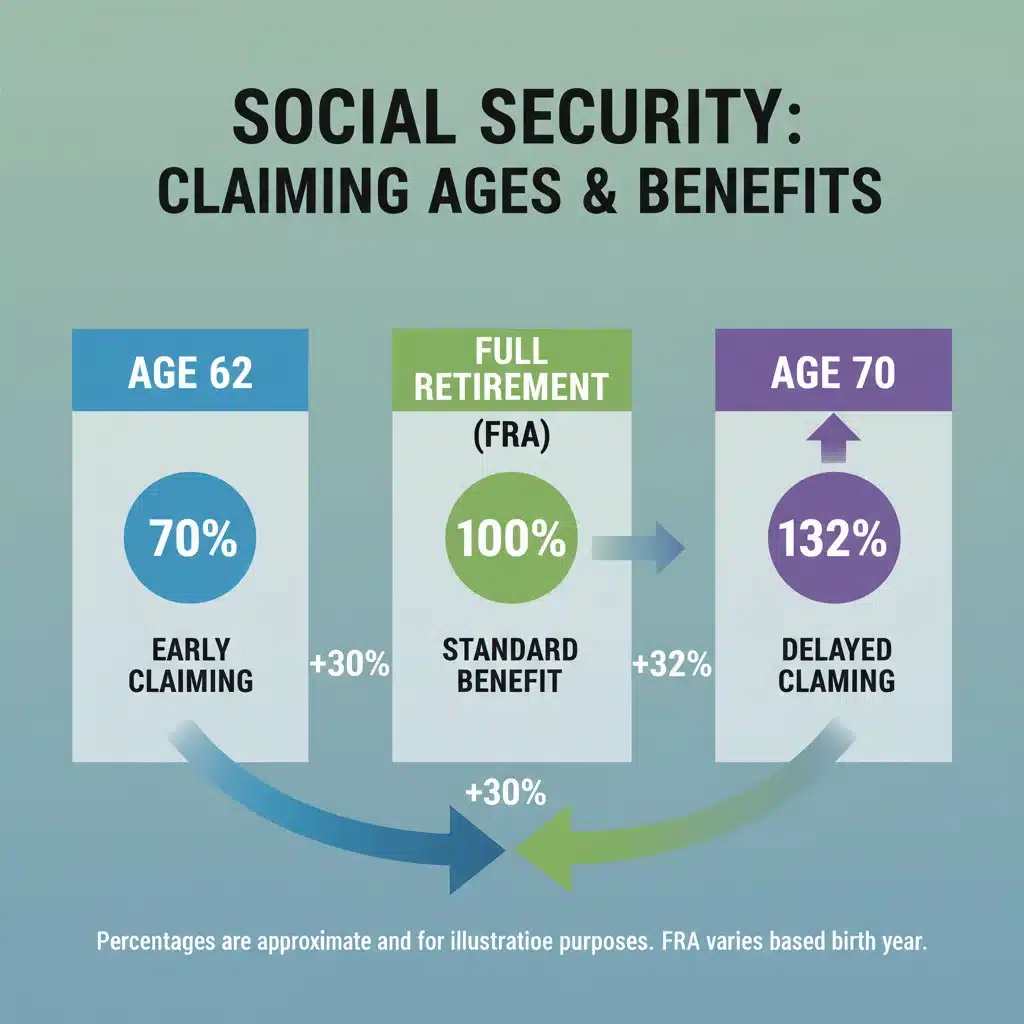
- Full Retirement Age (FRA): This is the age at which you are entitled to receive 100% of your primary insurance amount (PIA). For most people born after 1960, FRA is 67.
- Primary Insurance Amount (PIA): The benefit you would receive if you start collecting Social Security at your Full Retirement Age.
- Delayed Retirement Credits (DRCs): These are increases in your benefit amount for each month you delay claiming Social Security past your FRA, up to age 70. These credits can add up to an 8% increase per year.
- Cost-of-Living Adjustments (COLAs): Annual adjustments to Social Security benefits to keep pace with inflation.
The Power of Delay: Boosting Benefits by Up to 8% Annually
One of the most impactful strategies to maximize social security is delaying your claim. While you can start receiving benefits as early as age 62, doing so will permanently reduce your monthly payment. Conversely, waiting past your Full Retirement Age (FRA) can significantly increase your benefits.
How Delayed Retirement Credits Work:
For every year you delay claiming Social Security past your FRA, up to age 70, your benefit amount increases by a certain percentage. This increase is known as Delayed Retirement Credits (DRCs). For those born in 1943 or later, the annual increase is 8%. This means that if your FRA is 67, and you wait until age 70 to claim, you could increase your monthly benefit by 24% (3 years x 8% per year).
Anúncios
Consider this scenario: If your PIA at age 67 is $2,000, by delaying until age 70, your monthly benefit would increase to $2,480 (a $480 increase per month!). Over a long retirement, this can amount to tens or even hundreds of thousands of dollars in additional income. This 8% annual increase is a powerful incentive to carefully consider your claiming age.
Factors to Consider When Delaying:
- Health and Longevity: If you expect to live a long life, delaying benefits often makes financial sense, as you–ll receive a higher monthly payment for more years.
- Current Income Needs: Do you need the income immediately to cover living expenses? If not, delaying might be a viable option.
- Other Retirement Savings: If you have substantial other retirement savings (401(k), IRA, etc.), you might be able to draw from those accounts to bridge the gap until you claim Social Security at a later age.
- Spousal Considerations: Delaying can also impact spousal benefits, which we’ll discuss shortly.
Strategic Claiming for Couples: Maximizing Household Benefits
For married couples, the claiming decisions become more complex but also offer more opportunities to maximize social security benefits for the household. Coordination is key.
Spousal Benefits:
If your spouse has a higher earnings record, you might be eligible for spousal benefits. A spouse can receive up to 50% of the working spouse’s PIA. However, you can only claim spousal benefits once your spouse has filed for their own benefits.
Key Strategies for Couples:
- Higher Earner Delays: Generally, the higher-earning spouse should delay claiming benefits until age 70 to maximize their own benefit, which will also maximize the potential survivor benefit for the lower-earning spouse.
- Lower Earner Files Early: The lower-earning spouse might consider claiming their own benefit as early as age 62 (or their FRA) to provide some income while the higher earner delays. Once the higher earner files, the lower earner might be able to switch to a higher spousal benefit if 50% of the higher earner’s PIA is greater than their own benefit.
- Survivor Benefits: When one spouse passes away, the surviving spouse can claim the higher of their own benefit or the deceased spouse’s benefit. By maximizing the higher earner’s benefit through delay, you also maximize the survivor benefit for the remaining spouse.
It’s crucial for couples to run various scenarios using the Social Security Administration’s (SSA) online tools or consult a financial advisor to determine the optimal claiming strategy for their unique situation.
Working in Retirement: Impact on Benefits
Many individuals choose to continue working part-time or full-time in retirement. While this can provide additional income, it can also affect your Social Security benefits if you claim before your Full Retirement Age (FRA).
The Earnings Test:
If you claim Social Security before your FRA and continue to work, your benefits may be reduced if your earnings exceed a certain annual limit. For 2024, if you are under FRA for the entire year, the SSA will deduct $1 from your benefits for every $2 you earn above $22,320. In the year you reach FRA, the reduction is $1 for every $3 earned above a higher limit ($59,520 in 2024) until the month you reach FRA.
Once you reach your FRA, the earnings test no longer applies, and you can earn any amount without your Social Security benefits being reduced. Furthermore, any benefits withheld due to the earnings test are not lost; your monthly benefit will be recalculated at your FRA to account for the withheld amounts, effectively increasing your future payments.
How Working Can Still Help You Maximize Social Security:
- Replacing Low-Earning Years: Social Security calculates your benefit based on your 35 highest-earning years. If you continue working in retirement and earn more than you did in one of your previous 35 highest-earning years, your new higher earnings could replace an older, lower-earning year, potentially increasing your PIA.
- Delaying Your Claim: Working longer can provide the necessary income to delay claiming Social Security, allowing you to earn those valuable Delayed Retirement Credits and significantly boost your monthly payment.
Divorced Spousal Benefits: Don’t Overlook This Opportunity
If you were married for at least 10 years and are now divorced, you might be eligible for benefits based on your ex-spouse’s earnings record, even if they have remarried. This can be a critical strategy to maximize social security for many individuals.
Eligibility Requirements:
- Your marriage lasted 10 years or longer.
- You are currently unmarried.
- You are age 62 or older.
- Your ex-spouse is entitled to Social Security retirement or disability benefits.
- The benefit you would receive based on your own work record is less than the benefit you would receive based on your ex-spouse’s work record.
The best part? Claiming benefits as a divorced spouse does not affect your ex-spouse’s benefits or their current spouse’s benefits. You can claim divorced spousal benefits even if your ex-spouse has not yet filed for their own benefits, provided you have been divorced for at least two years.
Understanding Social Security Taxation: What You Need to Know
While often overlooked in claiming strategies, understanding how Social Security benefits are taxed is vital for comprehensive financial planning and can indirectly help you maximize social security by optimizing your overall retirement income.
Provisional Income:
The amount of your Social Security benefits subject to federal income tax depends on your “provisional income,” which is calculated as:
Adjusted Gross Income (AGI) + Nontaxable interest + One-half of your Social Security benefits.
Taxation Tiers:
- Up to 50% Taxable: If your provisional income is between $25,000 and $34,000 for an individual, or between $32,000 and $44,000 for a married couple filing jointly, up to 50% of your Social Security benefits may be taxable.
- Up to 85% Taxable: If your provisional income exceeds $34,000 for an individual or $44,000 for a married couple filing jointly, up to 85% of your Social Security benefits may be taxable.
Some states also tax Social Security benefits, so it’s important to check your state’s tax laws. Strategic management of your retirement withdrawals (e.g., Roth conversions, timing of capital gains) can help keep your provisional income lower, potentially reducing the tax on your Social Security benefits.
Other Considerations to Maximize Social Security
Review Your Earnings Record Regularly:
The Social Security Administration (SSA) keeps a record of your earnings throughout your working life. These records are used to calculate your benefits. It’s crucial to check your earnings record periodically for accuracy. You can do this by creating an account on the SSA’s website (ssa.gov). Errors, such as missing years of earnings, could lead to lower benefits. If you find an error, you can submit corrected information to the SSA.
Consider All Benefit Types:
Beyond retirement benefits, Social Security also offers disability and survivor benefits. While our focus is on retirement, understanding these other programs is part of a holistic approach to financial security. For instance, if you become disabled before retirement, claiming disability benefits might be more advantageous than waiting. Similarly, if you are a widow or widower, investigate survivor benefits.
Impact of Government Pensions:
If you worked for a government agency (federal, state, or local) and did not pay Social Security taxes on those earnings, your Social Security benefits might be reduced by the Windfall Elimination Provision (WEP) or your spousal/survivor benefits might be reduced by the Government Pension Offset (GPO). It’s essential to understand how these provisions might affect your benefits and plan accordingly.
Consult a Financial Advisor:
Social Security rules are complex, and every individual’s situation is unique. A qualified financial advisor specializing in retirement planning can help you navigate these complexities, analyze your specific circumstances, and develop a personalized strategy to maximize social security benefits. They can use specialized software to model different claiming scenarios and help you understand the long-term financial implications of each choice.
Planning for 2026: What to Expect
While specific changes to Social Security benefits for 2026 are not yet finalized, the general principles of maximizing benefits remain constant. The 8% annual Delayed Retirement Credits are a statutory provision and are expected to continue. However, other factors like the Cost-of-Living Adjustment (COLA), the earnings test limits, and the maximum taxable earnings amount are adjusted annually.
It’s always wise to stay updated on announcements from the Social Security Administration regarding these annual adjustments. These can influence your overall retirement income and should be factored into your long-term financial planning.
For instance, a higher COLA can mean a more substantial increase in your monthly payments, while changes to the earnings limit might affect those who plan to work while claiming early benefits. Being proactive in monitoring these changes will allow you to make informed decisions and adapt your strategy as needed.

The Importance of a Holistic Retirement Plan
While Social Security is a crucial component of retirement income, it’s rarely sufficient on its own. A truly secure retirement involves a holistic approach that integrates Social Security planning with other savings and investment strategies. To truly maximize social security, you must also maximize your overall retirement portfolio.
Key Elements of a Holistic Plan:
- Personal Savings: 401(k)s, IRAs (Traditional and Roth), and other investment accounts are essential. Maximize contributions to these accounts throughout your working life.
- Healthcare Costs: Plan for rising healthcare costs, including Medicare premiums, deductibles, and out-of-pocket expenses. Consider long-term care insurance.
- Debt Management: Aim to enter retirement debt-free, especially from high-interest consumer debt.
- Estate Planning: Ensure your will, trusts, and beneficiary designations are up-to-date.
- Emergency Fund: Maintain a robust emergency fund to cover unexpected expenses without dipping into your long-term retirement savings.
By viewing Social Security not in isolation, but as a critical piece of a larger financial puzzle, you can create a more resilient and comfortable retirement. The goal is not just to get the most out of Social Security, but to ensure all your financial resources work together effectively to support your desired lifestyle in retirement.
Conclusion: Take Control of Your Social Security Future
The decisions surrounding when and how to claim your Social Security benefits are among the most important financial choices you’ll make. By understanding the rules, exploring all available strategies, and planning diligently, you have the power to significantly maximize social security payouts. Delaying benefits, coordinating with a spouse, reviewing your earnings record, and understanding taxation are all vital components of this process. Don’t leave money on the table; take the time to educate yourself, consider your options, and seek professional advice to secure the highest possible Social Security income for a more comfortable and worry-free retirement. The 8% annual increase for delayed claiming is a powerful incentive, making careful planning for 2026 and beyond an absolute must for your financial future.