Medicare Part B 2026: Premium Adjustments, Expectations, and Cost Reduction Strategies

Anúncios
Medicare Part B 2026: Navigating Premium Adjustments and Strategies to Save
As we look towards 2026, many seniors and those approaching Medicare eligibility are keenly interested in understanding potential adjustments to their Medicare Part B premiums. Healthcare costs are a significant concern for retirees, and fluctuations in premiums can have a substantial impact on monthly budgets. This comprehensive guide will delve into what you can expect regarding Medicare Part B 2026 premium adjustments, the factors that influence these changes, and crucially, actionable strategies you can employ to potentially reduce your monthly costs by a significant margin, possibly even 10% or more.
Anúncios
Understanding Medicare Part B is the first step. Part B covers medically necessary services and preventive services, including doctor visits, outpatient care, medical equipment, and some home health services. Unlike Part A (hospital insurance), which is often premium-free for most people, Part B always carries a monthly premium. This premium is standardized for most beneficiaries, but for higher-income individuals, an Income-Related Monthly Adjustment Amount (IRMAA) can significantly increase their costs. Preparing for Medicare Part B 2026 means understanding these nuances and planning ahead.
Understanding the Medicare Part B 2026 Premium Landscape
The Centers for Medicare & Medicaid Services (CMS) typically announces the standard Medicare Part B premium for the upcoming year in the fall. While we don’t have the official figures for Medicare Part B 2026 yet, we can anticipate the factors that will drive these adjustments. Several key elements contribute to the annual determination of Part B premiums:
Anúncios
Factors Influencing Premium Adjustments
- Healthcare Spending Trends: Overall national healthcare expenditures, particularly for physician services and outpatient care, play a major role. If these costs rise, it often translates to higher Part B premiums.
- Utilization of Services: Changes in how often beneficiaries use Part B covered services, and the types of services they utilize, can impact the premium calculation.
- Medicare Trust Fund Solvency: The financial health of the Supplementary Medical Insurance (SMI) Trust Fund, which pays for Part B (and Part D), is continually monitored. Premiums are set to cover a portion (typically 25%) of the projected costs for these benefits.
- Congressional Action: While less common, Congress can intervene to limit premium increases, especially during periods of economic hardship or significant cost jumps.
- Hold Harmless Provision: This provision protects about two-thirds of Medicare beneficiaries from premium increases if their Social Security cost-of-living adjustment (COLA) is not large enough to cover the premium hike. However, this protection doesn’t apply to everyone, especially those subject to IRMAA.
- New Drug and Treatment Costs: The introduction of expensive new drugs and medical technologies can significantly impact Medicare’s overall spending and, consequently, Part B premiums.
Historically, Medicare Part B premiums have seen gradual increases, with occasional larger jumps due to specific factors, such as the introduction of new, expensive drugs or economic shifts. For Medicare Part B 2026, it’s prudent to prepare for a potential increase, even if modest, and understand how it might affect your personal finances.
The Impact of Income: Medicare IRMAA for 2026
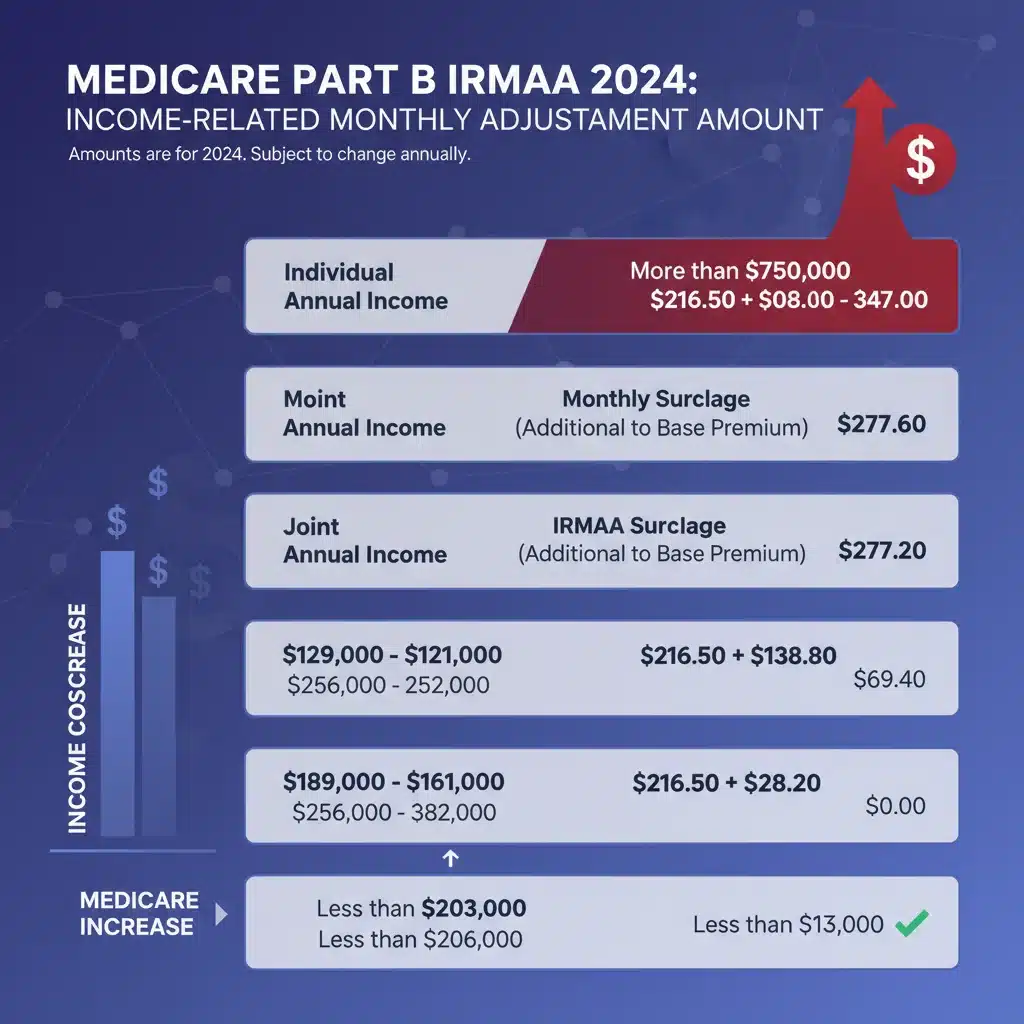
One of the most significant factors affecting individual Medicare Part B premiums is income. The Income-Related Monthly Adjustment Amount (IRMAA) means that if your modified adjusted gross income (MAGI) exceeds certain thresholds, you will pay a higher Part B premium. These thresholds are adjusted annually for inflation, and understanding the potential IRMAA for Medicare Part B 2026 is critical for financial planning.
How IRMAA Works
IRMAA is based on your MAGI from two years prior. So, for Medicare Part B 2026 premiums, the Social Security Administration (SSA) will typically look at your 2024 tax return. MAGI includes your adjusted gross income (AGI) plus tax-exempt interest income. The SSA uses a tiered system, with different income brackets corresponding to different IRMAA surcharges.
It’s important to note that IRMAA not only affects your Part B premium but also your Medicare Part D (prescription drug coverage) premium. So, a higher income can lead to increased costs across multiple Medicare components.
Anticipating IRMAA Thresholds for Medicare Part B 2026
While the exact IRMAA thresholds for Medicare Part B 2026 will be released later, they generally increase each year to account for inflation. However, even with inflation adjustments, many retirees find themselves in higher IRMAA brackets due to various income sources, including:
- Social Security benefits
- Taxable pensions and annuities
- Distributions from traditional IRAs and 401(k)s
- Capital gains
- Taxable interest and dividends
- Rental income
Careful financial planning, especially regarding withdrawals from retirement accounts, can significantly impact your MAGI and, consequently, your Medicare Part B 2026 premiums.
Strategies to Potentially Reduce Your Medicare Part B 2026 Costs by 10% or More
For many seniors, reducing healthcare costs is a top priority. While some factors are beyond individual control, there are several proactive strategies you can employ to potentially lower your Medicare Part B 2026 premiums, especially if you are concerned about IRMAA or simply want to optimize your healthcare spending.
1. Strategic Income Planning to Avoid or Reduce IRMAA
This is arguably the most impactful strategy for those nearing or in retirement. Since IRMAA is based on your MAGI from two years prior, planning your income stream can help you stay below IRMAA thresholds.
- Roth Conversions: Converting traditional IRA or 401(k) funds to a Roth IRA during lower-income years (e.g., before you start drawing Social Security or other pensions) can be a powerful strategy. While the conversion itself is a taxable event and increases your MAGI in that year, subsequent qualified Roth withdrawals in retirement are tax-free and do not count towards MAGI for IRMAA purposes. This can lead to significant savings on Medicare Part B 2026 and beyond.
- Qualified Charitable Distributions (QCDs): If you are 70½ or older and have a traditional IRA, you can make QCDs directly from your IRA to a qualified charity. These distributions count towards your Required Minimum Distributions (RMDs) but are not included in your MAGI, effectively lowering your taxable income and potentially helping you avoid or reduce IRMAA.
- Tax-Efficient Withdrawal Strategies: Work with a financial advisor to create a withdrawal strategy that minimizes your MAGI. This might involve drawing from different types of accounts (taxable, tax-deferred, tax-free) in a specific order. For instance, prioritizing withdrawals from Roth accounts or taxable brokerage accounts before traditional IRAs could keep your MAGI lower in certain years.
- Delaying Social Security (in some cases): While delaying Social Security increases your monthly benefit, which is partially taxable, the overall impact on IRMAA needs careful calculation. For some, delaying Social Security might allow for other income-generating activities to be managed more effectively, thus keeping MAGI lower.
2. Appealing an IRMAA Determination
If you receive an IRMAA determination notice for Medicare Part B 2026 and your income has significantly decreased since the tax year used for the calculation (e.g., due to retirement, divorce, death of a spouse, or loss of income-producing property), you have the right to appeal. This is a crucial strategy that many people overlook.
- Life-Changing Events: The SSA has specific categories of “life-changing events” that allow for an appeal. These include: cessation of work, work reduction, loss of income-producing property, loss of an employer pension, settlement from an employer, or divorce/annulment.
- Filing an Appeal: You will need to complete Form SSA-44, “Medicare Income-Related Monthly Adjustment Amount – Life-Changing Event.” You’ll also need to provide documentation to support your claim (e.g., a letter from your former employer confirming retirement, divorce decree, etc.). The SSA will then review your case and may use a more recent tax year’s income (or a projection of current year income) to determine your Part B premium. This can potentially reduce your Medicare Part B 2026 premium significantly.
3. Exploring Medicare Advantage Plans (Part C)
While Medicare Part B 2026 premiums are a given for Original Medicare, Medicare Advantage (MA) plans (Part C) can sometimes offer a way to manage your overall healthcare costs. Many MA plans have a $0 monthly premium (though you still pay your Part B premium), and they often include Part D prescription drug coverage and additional benefits like dental, vision, and hearing.
- Lower Out-of-Pocket Costs: Some MA plans have lower out-of-pocket maximums compared to Original Medicare plus a Medigap plan.
- Coordinated Care: MA plans often use managed care networks, which can lead to more coordinated care and potentially lower costs if you stay within the network.
- Important Considerations: Be aware that MA plans typically have network restrictions and require referrals for specialists. Carefully compare the benefits, costs, and provider networks of MA plans in your area during the Annual Enrollment Period (AEP) to see if one aligns with your needs and could lead to overall savings on your Medicare Part B 2026 related expenses.
4. Enrolling in a Medicare Savings Program (MSP)
For individuals with limited income and resources, Medicare Savings Programs can provide significant relief by helping to pay for Medicare Part B premiums, deductibles, and co-insurance. There are several types of MSPs, each with different income and resource limits:
- Qualified Medicare Beneficiary (QMB) Program: Pays for Part A and Part B premiums, deductibles, coinsurance, and copayments.
- Specified Low-Income Medicare Beneficiary (SLMB) Program: Pays for Part B premiums only.
- Qualifying Individual (QI) Program: Pays for Part B premiums only.
- Qualified Disabled and Working Individuals (QDWI) Program: Pays for Part A premiums for certain disabled individuals who lost their premium-free Part A when they returned to work.
Even if you think your income is too high, it’s worth checking the eligibility requirements for these programs, as they are often more generous than you might expect. Applying for an MSP can directly reduce your monthly Medicare Part B 2026 premium to $0, representing a 100% reduction for the standard premium amount.
5. Reviewing and Adjusting Your Medigap Policy
If you have Original Medicare, you likely also have a Medigap (Medicare Supplement) policy to cover the gaps in Original Medicare. While Medigap premiums are separate from Medicare Part B 2026 premiums, they are a significant part of your overall healthcare costs. Regularly reviewing your Medigap policy can lead to savings.
- Shop Around Annually: Medigap premiums can vary significantly between insurance companies for the same plan letter (e.g., Plan G). As you age, your premiums may increase. Shopping around annually, especially during your birthday month (in some states), can help you find a more affordable policy without sacrificing benefits.
- Consider Lower-Cost Plans: If your health is good and you are comfortable with a higher deductible, a high-deductible Plan G or F (if eligible) could offer substantially lower monthly premiums. While you’d pay more out-of-pocket before your Medigap plan kicks in, the annual premium savings could outweigh this for some individuals.
- Switching from Plan F to Plan G: If you enrolled in Medicare before January 1, 2020, you might have Plan F, which covers the Part B deductible. Newer enrollees cannot purchase Plan F. Switching to Plan G, which is identical to Plan F except it doesn’t cover the Part B deductible, can often result in lower premiums, even after accounting for the deductible you would pay yourself. For Medicare Part B 2026, this small change could lead to noticeable savings.

6. Maximizing Preventive Care and Staying Healthy
While this strategy doesn’t directly reduce your Medicare Part B 2026 premium, it can significantly lower your overall healthcare expenditures. Medicare Part B covers a wide range of preventive services, many at no cost to you. Utilizing these services can help detect health issues early, preventing more serious and expensive conditions down the road.
- Annual Wellness Visit: Make sure to schedule your annual wellness visit, which is covered 100% by Medicare Part B.
- Screenings and Vaccinations: Take advantage of covered screenings for cancer, diabetes, cardiovascular disease, and necessary vaccinations (flu, pneumonia, shingles).
- Healthy Lifestyle: Maintaining a healthy lifestyle through diet, exercise, and stress management can reduce the need for medical interventions, thus lowering your out-of-pocket costs for co-pays and deductibles.
Important Considerations for Medicare Part B 2026 Planning
As you plan for Medicare Part B 2026, keep these additional points in mind:
Stay Informed
Official announcements regarding Medicare Part B 2026 premiums and IRMAA thresholds typically come from the CMS and the Social Security Administration in the fall of the preceding year. Stay tuned to reliable sources for the most up-to-date information.
Consult with Professionals
Navigating Medicare and retirement finances can be complex. Consider consulting with:
- A Financial Advisor: Especially one specializing in retirement planning, to help with tax-efficient withdrawal strategies, Roth conversions, and overall income management to minimize IRMAA for Medicare Part B 2026.
- A Medicare Counselor (SHIP): State Health Insurance Assistance Programs (SHIPs) offer free, unbiased counseling on all aspects of Medicare. They can help you understand your options, compare plans, and navigate appeal processes.
- A Tax Professional: To ensure your income planning aligns with tax laws and optimizes your MAGI for Medicare purposes.
Don’t Overlook Part D IRMAA
Remember that if you are subject to IRMAA for Part B, you will also pay an IRMAA for your Medicare Part D prescription drug plan. The same income-planning and appeal strategies apply to Part D IRMAA as well.
Annual Enrollment Period (AEP)
The AEP, from October 15 to December 7 each year, is your opportunity to make changes to your Medicare coverage that will take effect on January 1 of the following year. This is the time to review your Medicare Advantage plan, Part D plan, and potentially your Medigap options to ensure they are still the best fit for your needs and budget, especially in light of Medicare Part B 2026 adjustments.
Conclusion: Proactive Planning for Medicare Part B 2026 is Key
While the exact figures for Medicare Part B 2026 premiums are yet to be released, understanding the underlying factors and proactive strategies can empower you to manage your healthcare costs effectively. By strategically planning your income, exploring appeal options, considering different Medicare plan types, and reviewing your supplemental coverage, you can take significant steps towards potentially reducing your monthly Medicare Part B expenses, possibly by 10% or even more. Don’t wait until the last minute; start your planning today to ensure a secure and affordable healthcare future.
The landscape of Medicare is constantly evolving, and staying informed is your best defense against unexpected costs. By implementing these strategies, you can navigate the Medicare Part B 2026 adjustments with confidence and maintain control over your retirement budget. Your health and financial well-being depend on it.