Velocity of Money in US Economy 2025: Insider Insights
Anúncios
Understanding the velocity of money in the U.S. economy for 2025 is crucial for gauging economic health, as it reveals how frequently a unit of currency is used to purchase goods and services within a specific period.
Anúncios
As we navigate the complexities of the modern financial landscape, Understanding the Velocity of Money in the U.S. Economy for 2025 – INSIDER KNOWLEDGE becomes paramount for investors, policymakers, and everyday citizens alike. This often-overlooked metric provides profound insights into economic dynamism and inflationary pressures, shaping the economic narrative that will unfold in the coming year.
Defining the velocity of money and its significance
The velocity of money is a fundamental concept in macroeconomics, representing the rate at which money is exchanged from one transaction to another. It essentially measures how many times a single unit of currency is used to purchase domestically produced goods and services within a given period. A higher velocity suggests a more active and dynamic economy, while a lower velocity can indicate sluggish economic activity or a preference for saving over spending.
Anúncios
Understanding this metric is crucial because it directly influences inflation, economic growth, and the overall effectiveness of monetary policy. For 2025, anticipating shifts in money velocity will be key to forecasting economic stability and potential challenges. This concept, though seemingly simple, encapsulates a complex interplay of consumer behavior, business investment, and central bank actions.
The quantity theory of money and velocity
At its core, the velocity of money is often discussed in conjunction with the quantity theory of money, which posits that the money supply multiplied by the velocity of money equals the nominal GDP. This relationship is expressed as M * V = P * Y, where M is the money supply, V is the velocity of money, P is the price level, and Y is the real output (GDP). If M and Y are relatively stable, then changes in V can directly impact P, and thus inflation.
- Money Supply (M): The total amount of money circulating in the economy.
- Velocity (V): The rate at which money changes hands.
- Price Level (P): The average level of prices for goods and services.
- Real Output (Y): The total volume of goods and services produced.
For 2025, monitoring these components in tandem will offer a holistic view of the economic landscape. A significant increase in money supply without a corresponding increase in real output, coupled with stable or rising velocity, could signal inflationary pressures. Conversely, a decline in velocity, even with an expanding money supply, might suggest deflationary risks or a subdued economic recovery.
In conclusion, the velocity of money is more than just a theoretical construct; it is a live indicator reflecting the pulse of economic transactions. Its significance for 2025 lies in its ability to offer early warnings about shifts in consumer confidence, investment patterns, and the potential impact of ongoing monetary policies.
Historical trends and recent dynamics
To truly grasp the potential trajectory of money velocity in 2025, it is essential to examine its historical performance and the factors that have shaped its recent dynamics. The U.S. has experienced significant fluctuations in money velocity over the decades, often correlated with major economic events and policy responses. Post-2008 financial crisis, for instance, saw a notable decline in velocity, a trend that continued for many years.
This prolonged decline was attributed to several factors, including increased savings rates, reduced lending by banks, and a general deleveraging by households and businesses. The Federal Reserve’s quantitative easing programs, while expanding the money supply, did not always translate into a proportionate increase in transactional activity, leading to a lower velocity.
The impact of the COVID-19 pandemic
The COVID-19 pandemic introduced unprecedented economic shocks, further complicating the dynamics of money velocity. Initial lockdowns and economic uncertainty led to a sharp drop in consumer spending and business investment, which naturally depressed velocity. However, subsequent fiscal stimulus packages and accommodative monetary policies injected massive amounts of liquidity into the system.
- Initial Shock: Reduced spending, increased uncertainty, sharp decline in velocity.
- Stimulus Response: Government aid and central bank actions expanded money supply.
- Behavioral Shifts: Increased precautionary savings, reduced face-to-face transactions.
- Digital Adoption: Accelerated shift towards digital payments and online commerce.
Despite the substantial increase in money supply during the pandemic, the velocity of money remained stubbornly low. This phenomenon is partly explained by behavioral changes, such as increased precautionary savings by households and businesses, and a shift towards holding more cash or low-yielding assets due to uncertainty. The money was available, but it wasn’t circulating as frequently through the economy in goods and services transactions.
Understanding these recent dynamics is crucial for projecting 2025. The lingering effects of the pandemic, coupled with evolving consumer and business habits, will undoubtedly play a significant role in determining whether velocity begins to rebound or continues its subdued trajectory.
Key factors influencing velocity in 2025
Several critical factors will likely shape the velocity of money in the U.S. economy as we head into 2025. These influences are multifaceted, ranging from broad macroeconomic conditions to specific policy decisions and technological advancements. Discerning their potential impact is essential for any informed economic outlook.
One of the primary drivers will be consumer confidence and spending habits. If households feel secure about their job prospects and financial future, they are more likely to spend, increasing the velocity of money. Conversely, persistent inflation or economic uncertainty could lead to increased savings and reduced transactional activity, thus lowering velocity.
Monetary policy and interest rates
The Federal Reserve’s monetary policy stance will be a dominant factor. Higher interest rates typically incentivize saving over spending, which can reduce money velocity. Conversely, lower rates might encourage borrowing and investment, potentially boosting velocity. The Fed’s balance sheet management, including any quantitative tightening or easing measures, will also influence the overall money supply and its circulation.
- Interest Rate Hikes: Can slow down spending and investment, reducing velocity.
- Quantitative Tightening: Reduces the money supply, potentially impacting velocity.
- Inflation Expectations: High inflation might encourage spending now to avoid higher prices later, increasing velocity.
Another significant factor is the level of government spending and fiscal policy. Large government expenditures can inject money directly into the economy, potentially accelerating its circulation. However, the source of this spending (e.g., taxation vs. borrowing) and its ultimate allocation will determine its effectiveness in boosting velocity.
Technological advancements, particularly in financial technology (fintech) and digital payments, also play a role. Faster and more efficient payment systems can theoretically increase the speed at which money changes hands. However, the impact here is nuanced, as digital transactions also make it easier for money to be held in various digital accounts rather than immediately spent.
In summary, the velocity of money in 2025 will be a complex outcome of consumer and business sentiment, the evolving landscape of monetary and fiscal policies, and the continuing march of technological innovation in finance.
Projections for 2025: insider knowledge
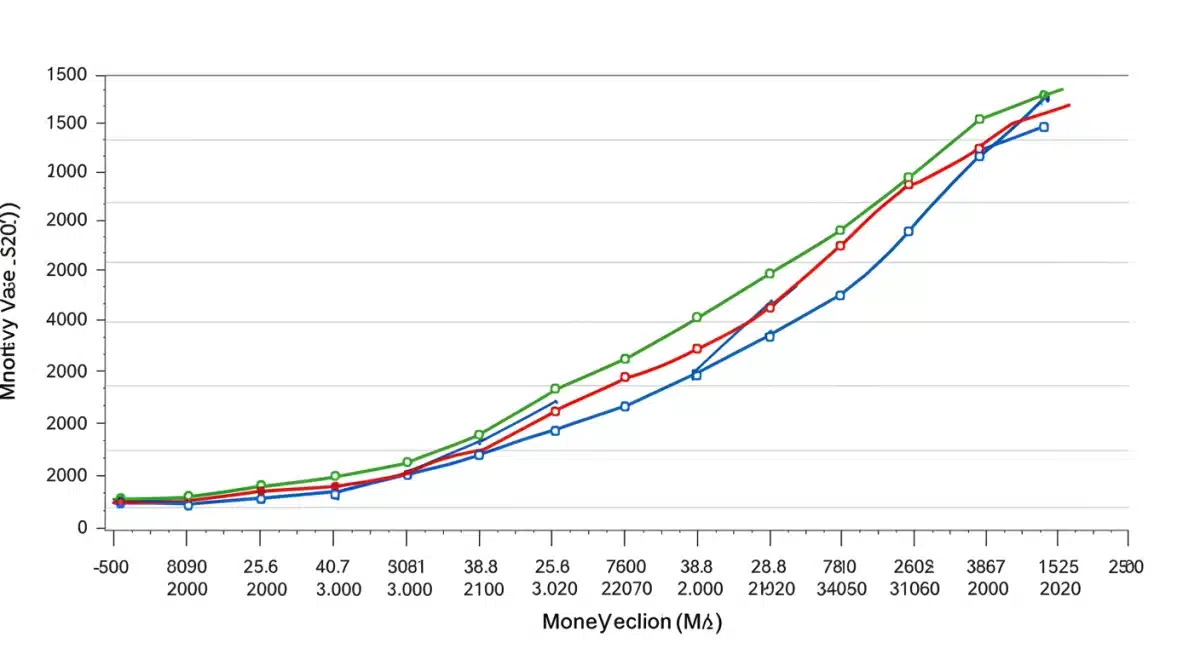
Forecasting the velocity of money for 2025 requires a blend of historical analysis, current economic indicators, and an understanding of potential policy shifts. Insider knowledge suggests a cautious optimism for a modest rebound in velocity, though a return to pre-2008 levels remains unlikely in the near term.
The consensus among many financial analysts is that the U.S. economy will likely experience continued but perhaps decelerating growth in 2025. This environment, characterized by a more stable inflation rate and potentially steady interest rates, could provide a foundation for a slight increase in money velocity. As supply chain issues ease and consumer confidence slowly rebuilds, transactional activity might pick up.
The role of corporate investment and consumer sentiment
A significant driver for any increase in velocity will be renewed corporate investment. Businesses that have deferred capital expenditures might begin to invest more aggressively, especially if they anticipate stable demand and a favorable regulatory environment. This investment translates into economic activity, increasing the speed at which money circulates.
- Corporate Reinvestment: Increased spending by businesses on expansion, technology, and hiring.
- Consumer Confidence: A sustained improvement in consumer outlook leads to higher discretionary spending.
- Wage Growth: Real wage increases empower consumers to spend more freely.
Furthermore, consumer sentiment will be paramount. If inflation moderates and real wages see sustained growth, households may feel more comfortable spending their accumulated savings or current income, rather than holding onto cash. This shift from saving to spending would directly contribute to higher money velocity.
Another aspect of insider knowledge points to the continued normalization of monetary policy. While significant rate hikes might be behind us, the Federal Reserve will likely maintain a vigilant stance, balancing inflation control with economic growth. A predictable policy environment can foster stability, which in turn encourages economic agents to transact more freely.
In essence, 2025 could see a gradual increase in money velocity driven by a more stable economic outlook, renewed investment, and a cautious return to pre-pandemic spending patterns, albeit with lingering effects of changed financial behaviors.
Implications for inflation and economic growth
The trajectory of money velocity in 2025 will have profound implications for both inflation and overall economic growth in the U.S. As a key component of the quantity theory of money, changes in velocity can significantly alter the relationship between money supply and price levels, and also reflect the underlying health of economic expansion.
If velocity begins to increase more substantially than anticipated, even with a stable money supply, it could reignite inflationary pressures. This scenario would mean that the existing money in the economy is being utilized more efficiently and frequently, chasing the same or a slightly growing pool of goods and services, thus pushing up prices.
Velocity and the effectiveness of monetary policy
The interaction between money velocity and monetary policy effectiveness is particularly crucial. A low and stagnant velocity can diminish the impact of central bank efforts to stimulate the economy through increasing the money supply. If money is injected into the system but not actively spent or invested, its stimulative effect is muted.
- Higher Velocity: Can amplify inflationary pressures if money supply is also high.
- Lower Velocity: Can dampen economic growth and reduce the effectiveness of stimulus.
- Policy Challenge: Central banks must balance money supply with velocity trends.
Conversely, a rising velocity in 2025 would mean that each dollar within the economy is contributing more to economic activity. This could translate into stronger GDP growth, as more transactions occur, and goods and services are exchanged more frequently. However, policymakers would need to closely monitor this acceleration to prevent overheating and excessive inflation.
For economic growth, a healthy and stable velocity of money indicates a robust and active economy where businesses are investing, and consumers are spending. A persistent decline, on the other hand, signals a cautious or stagnant economic environment, potentially leading to slower growth or even recessionary pressures.
Therefore, monitoring money velocity in 2025 will be an indispensable tool for policymakers and investors alike, providing critical insights into the underlying inflationary dynamics and the true momentum of economic expansion.
Strategies for navigating a changing velocity landscape
For businesses, investors, and policymakers, understanding and adapting to changes in money velocity in 2025 will be crucial for strategic decision-making. The landscape of monetary circulation is dynamic, and proactive strategies are necessary to mitigate risks and capitalize on opportunities.
For investors, a rising velocity could indicate a more inflationary environment, prompting a shift towards inflation-hedging assets such as real estate, commodities, or inflation-protected securities. Conversely, a continued low velocity might suggest a preference for stable, income-generating assets or those less sensitive to economic cycles.
Business adaptation and operational efficiency
Businesses will need to be agile in their operational strategies. If velocity increases, indicating stronger demand, companies might consider expanding production, investing in new technologies, and optimizing supply chains to meet higher consumer spending. This could involve increasing inventory levels and hiring more staff.
- Inventory Management: Adjusting stock levels based on anticipated transactional activity.
- Pricing Strategies: Adapting pricing to reflect inflationary or deflationary pressures.
- Investment Decisions: Timing capital expenditures with economic upswings or downturns.
- Cash Flow Optimization: Ensuring efficient management of working capital.
Policymakers, particularly the Federal Reserve, will face the challenge of fine-tuning monetary policy in response to evolving velocity trends. If velocity remains low, further stimulus might be considered, though with careful consideration of its potential impact on asset bubbles. If velocity rises rapidly, pre-emptive measures to cool the economy and control inflation might be necessary.
Consumers, too, can adapt by maintaining robust personal financial planning. This includes budgeting for potential inflationary impacts, diversifying savings and investments, and being mindful of debt levels. Understanding that their collective spending and saving habits directly influence money velocity can empower them to make more informed financial choices.
Ultimately, navigating the changing velocity landscape in 2025 requires constant vigilance and a willingness to adjust strategies across all sectors of the economy. Flexibility and foresight will be key to thriving in an evolving financial environment.
| Key Aspect | Description for 2025 |
|---|---|
| Definition | Measures how often money changes hands in the U.S. economy for goods/services. |
| Driving Factors | Consumer confidence, interest rates, government spending, and fintech adoption. |
| 2025 Outlook | Modest rebound expected, influenced by economic stability and corporate investment. |
| Implications | Directly impacts inflation, economic growth, and the effectiveness of monetary policy. |
Frequently asked questions about money velocity
The velocity of money measures how quickly money circulates in an economy. It indicates the average number of times a unit of currency is spent on goods and services within a specific period, usually a year, reflecting the pace of economic transactions.
Money velocity has been low due to factors like increased precautionary savings, reduced lending, deleveraging by households post-crisis, and a preference for holding cash amid economic uncertainty. Despite increased money supply, transactional activity remained subdued.
According to the quantity theory of money, if money supply and output are stable, a rising velocity can lead to higher inflation as money circulates more rapidly, chasing available goods and services. Conversely, low velocity can temper inflationary pressures.
Key influences for 2025 include consumer confidence, the Federal Reserve’s interest rate policies, government fiscal spending, and the ongoing adoption of digital payment technologies. These elements collectively shape transaction patterns.
The Federal Reserve cannot directly control money velocity. While its monetary policies (like interest rate adjustments or quantitative easing) influence money supply and incentives for spending, velocity is also heavily driven by consumer and business behavior, which is less directly controllable.
Conclusion
Understanding the Velocity of Money in the U.S. Economy for 2025 – INSIDER KNOWLEDGE reveals a complex interplay of monetary policy, consumer behavior, and technological shifts. While historical trends show a prolonged decline, 2025 may offer a modest rebound driven by economic stabilization and renewed confidence. Monitoring this vital metric will be essential for gauging inflationary pressures, economic growth, and the overall health of the U.S. financial system, guiding strategic decisions for all economic participants.