Recession Likelihood 2025: Expert Economic Indicators Analysis
Anúncios
The 2025 recession likelihood hinges on a complex interplay of inflation, interest rates, labor markets, and geopolitical stability, requiring a vigilant analysis of leading economic indicators to anticipate potential downturns and inform strategic planning.
Anúncios
As we navigate the ever-evolving global economic landscape, the question of a potential recession looms large for many. Understanding the 2025 recession likelihood requires a deep dive into various leading economic indicators, comparing current trends with historical patterns to gain clarity. This analysis aims to dissect the complex factors at play, offering an expert perspective on what the coming year might hold for the U.S. economy.
Anúncios
Understanding Leading Economic Indicators
Leading economic indicators are crucial tools for economists and policymakers alike, offering a glimpse into future economic activity. These metrics typically change before the economy as a whole does, making them invaluable for forecasting potential shifts, including downturns or upturns. Their predictive power, however, is not absolute, and they must be interpreted within a broader context of economic forces.
The array of leading indicators is diverse, encompassing everything from manufacturing orders to consumer confidence. Each indicator provides a unique piece of the puzzle, and a comprehensive analysis often involves examining several in conjunction. This holistic approach helps to mitigate the risk of false signals that any single indicator might present.
Key Categories of Leading Indicators
- Financial Market Indicators: Stock market performance, yield curve inversions, and credit spreads often signal changes in investor sentiment and economic expectations.
- Business and Manufacturing Metrics: New orders for durable goods, manufacturing new orders, and inventory levels can show future production trends.
- Consumer Sentiment and Behavior: Consumer confidence indices and housing starts reflect household economic health and future spending plans.
- Labor Market Data: Initial jobless claims, though often coincident, can sometimes act as a leading indicator for significant shifts in employment.
In essence, leading indicators serve as the economic equivalent of a weather forecast. While not always perfectly accurate, they provide the best available information to prepare for what lies ahead. Their careful study is fundamental to assessing the 2025 recession likelihood.
Inflationary Pressures and Interest Rate Trajectories
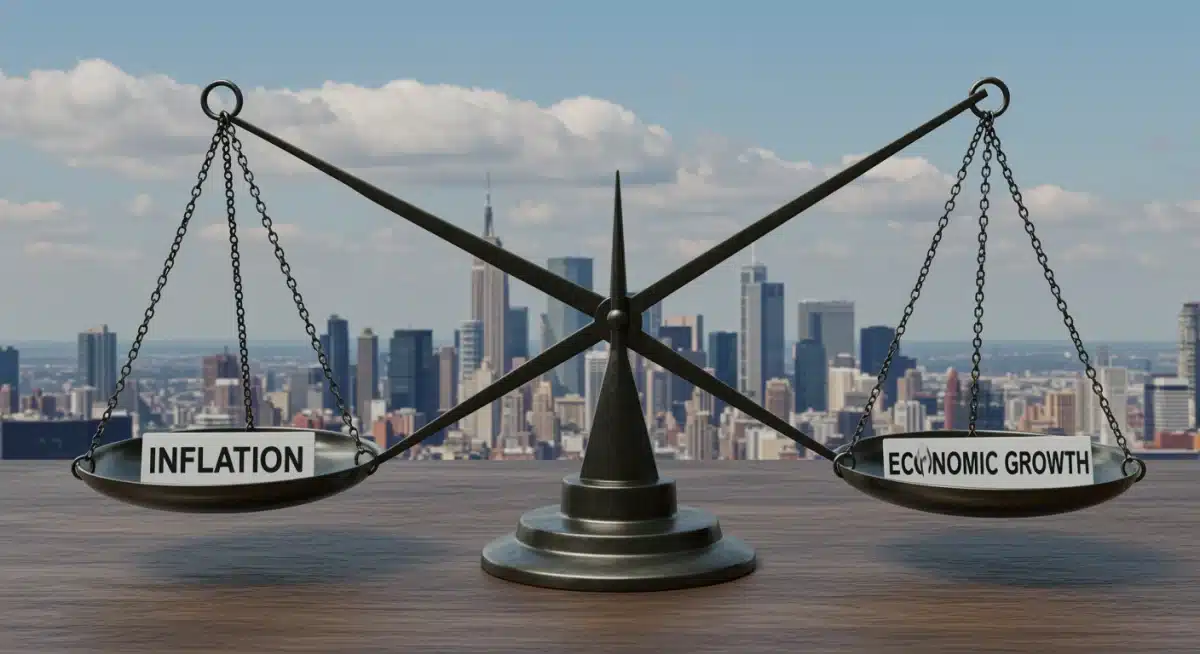
The twin forces of inflation and interest rates are arguably the most significant determinants of economic stability and, consequently, recession risk. Persistent high inflation erodes purchasing power, while aggressive interest rate hikes by central banks, aimed at taming inflation, can stifle economic growth by making borrowing more expensive for businesses and consumers.
The Federal Reserve’s actions in response to inflation have a direct impact on the cost of capital, influencing investment decisions, consumer spending, and the overall pace of economic expansion. Walking the tightrope between controlling inflation and avoiding a recession is a delicate balancing act that central banks worldwide are currently grappling with.
The Federal Reserve’s Stance
The Fed’s forward guidance on interest rates and its quantitative tightening policies are under constant scrutiny. Markets react swiftly to any signals regarding future rate hikes or cuts, pricing these expectations into asset values and borrowing costs. A misstep in monetary policy can exacerbate economic vulnerabilities, potentially accelerating a move towards recession.
Understanding the interplay between inflation and interest rates is critical for anyone trying to gauge the 2025 recession likelihood. If inflation proves more stubborn than anticipated, forcing the Fed to maintain higher rates for longer, the risk of an economic contraction increases significantly. Conversely, a rapid deceleration of inflation could pave the way for rate cuts, offering a boost to economic activity.
Labor Market Dynamics and Consumer Spending
A robust labor market and healthy consumer spending are often cited as pillars of a strong economy. Employment levels, wage growth, and consumer confidence directly influence household purchasing power and aggregate demand. Any significant weakening in these areas can signal an impending economic slowdown.
The current state of the labor market, characterized by low unemployment rates and steady wage gains in many sectors, provides a buffer against immediate recessionary pressures. However, underlying trends, such as slowing job creation or a rise in unemployment claims, warrant close attention as potential harbingers of change.
Consumer Confidence and Retail Sales
Consumer confidence surveys offer valuable insights into how households perceive their financial future and their willingness to spend. A sustained decline in confidence often precedes a reduction in discretionary spending, which can ripple through the economy. Retail sales figures, both online and in brick-and-mortar stores, serve as a direct measure of consumer activity.
- Employment Trends: Look for sustained increases in initial jobless claims and a deceleration in job growth as potential red flags.
- Wage Growth: While beneficial for consumers, excessively high wage growth can contribute to inflationary pressures, complicating monetary policy.
- Household Debt Levels: Rising debt burdens can constrain future spending, especially if interest rates remain elevated.
The resilience of the labor market and the trajectory of consumer spending will be pivotal in determining the economic path for 2025. A significant erosion of consumer purchasing power or a sharp rise in unemployment would undeniably increase the 2025 recession likelihood.
Geopolitical Factors and Supply Chain Resilience
Beyond domestic economic indicators, global geopolitical events and the resilience of supply chains play an increasingly vital role in economic stability. Conflicts, trade disputes, and natural disasters can disrupt the flow of goods and services, leading to supply shortages and inflationary pressures that are difficult for central banks to manage through monetary policy alone.
The interconnectedness of the global economy means that disturbances in one region can quickly propagate, affecting commodity prices, manufacturing output, and consumer costs worldwide. Assessing these external risks is an essential part of any comprehensive economic forecast.
Impact of Global Events
Recent years have demonstrated the profound impact of geopolitical events on economic performance. Energy prices, for instance, are highly sensitive to international tensions, and spikes can significantly impact business operating costs and household budgets. Similarly, disruptions to critical supply chains can lead to shortages and price increases for a wide range of goods.
Maintaining diverse and resilient supply chains has become a strategic priority for businesses and governments. The ability of companies to adapt to disruptions and secure alternative sources of supply can mitigate some of the economic fallout from unforeseen global events. However, systemic shocks can still pose a substantial threat.
- Energy Market Volatility: Fluctuations in oil and gas prices can have a cascading effect on transportation, manufacturing, and consumer prices.
- Trade Relations: Tariffs, protectionist policies, and trade disputes can hinder global economic growth and create uncertainty for businesses.
- Climate-Related Events: Natural disasters can devastate regional economies, disrupt supply chains, and impact agricultural output.
The unpredictable nature of geopolitical factors adds a layer of complexity to forecasting the 2025 recession likelihood. A stable international environment fosters economic confidence, while heightened tensions can quickly dampen it.
Historical Precedents and Current Divergences
Examining historical recessions provides valuable context for understanding current economic signals. While no two economic cycles are identical, past downturns often share common characteristics, such as inverted yield curves, sharp declines in consumer confidence, or significant shocks to the financial system. Comparing today’s environment with these precedents can offer insights into potential future trajectories.
However, it’s equally important to recognize the divergences. The global economy is constantly evolving, with new technologies, regulatory frameworks, and demographic shifts influencing economic dynamics. Relying solely on historical parallels without acknowledging current unique factors can lead to misinterpretations.
Yield Curve Inversion as a Predictor
One of the most widely watched historical indicators is the inversion of the yield curve, particularly the spread between the 10-year and 3-month Treasury yields. Historically, an inverted yield curve has preceded nearly every U.S. recession since the 1950s, though with varying lags. Its current state and trajectory are closely monitored by economists.
While the yield curve has shown inversions in recent periods, the question remains whether this signal will once again prove accurate, or if current economic conditions present a different outcome. Factors such as quantitative easing and global demand for safe assets can influence bond yields in ways that differ from historical norms.
Understanding both the continuities and discontinuities with past economic cycles is essential for a nuanced assessment of the 2025 recession likelihood. The economy is a dynamic system, and while history offers guidance, it does not provide a perfect blueprint for the future.
Forecasting Models and Expert Consensus
Economic forecasting relies on a blend of quantitative models, qualitative analysis, and expert judgment. Various institutions, from central banks to private research firms, employ sophisticated models to project economic growth, inflation, and employment. These models incorporate a wide range of leading and coincident indicators to generate their outlooks.
While models provide a structured approach to forecasting, they are inherently limited by their assumptions and the data available. Expert consensus, derived from surveys of economists, often helps to triangulate these projections, offering a broader perspective that accounts for factors difficult to quantify.
Challenges in Economic Forecasting
Predicting economic turning points, especially recessions, is notoriously challenging. Unexpected shocks, rapid policy shifts, or behavioral changes can quickly render even the most robust forecasts obsolete. The margin of error in economic models tends to increase significantly the further out the forecast horizon extends.
- Model Limitations: Forecasts are based on assumptions that may not hold true in rapidly changing environments.
- Data Lags: Economic data is often released with a lag, meaning forecasters are always working with slightly outdated information.
- Behavioral Economics: Human psychology and herd behavior can introduce irrationality that traditional models struggle to capture.
Despite these challenges, economic forecasts provide a framework for understanding potential scenarios and preparing for them. The range of expert opinions on the 2025 recession likelihood reflects the inherent uncertainties in economic prediction, highlighting the need for continuous monitoring and adaptive strategies.
| Key Indicator | Current Trend for 2025 |
|---|---|
| Inflation | Gradual moderation, though still above target in some areas, influencing Fed policy. |
| Interest Rates | Likely plateauing with potential for cuts if inflation cools significantly. |
| Labor Market | Remains relatively strong, but signs of cooling job growth are emerging. |
| Consumer Spending | Resilient but facing headwinds from elevated prices and higher borrowing costs. |
Frequently Asked Questions About the 2025 Recession
While no single indicator is definitive, an inverted yield curve has historically been a strong predictor of recessions. Coupled with persistent inflation and aggressive interest rate hikes, it presents a significant concern for the 2025 economic outlook.
Interest rate hikes increase borrowing costs for consumers and businesses, which can slow down economic activity by reducing investment and consumer spending. If rates rise too quickly or remain high for too long, they can trigger an economic contraction.
A strong labor market provides a significant buffer against a recession by supporting consumer spending. However, if other factors like high inflation or credit tightening become severe enough, even a robust job market might not be enough to avert a downturn.
Geopolitical events, such as conflicts or trade disputes, can disrupt supply chains, increase commodity prices, and reduce global demand. These external shocks can exacerbate existing economic vulnerabilities and increase the probability of a recession.
Economic forecasts offer valuable insights but are subject to limitations due to unforeseen events and data lags. While they provide a framework, they should be viewed as probabilities rather than certainties, requiring continuous monitoring of evolving indicators.
Conclusion
Assessing the 2025 recession likelihood is a multifaceted endeavor, demanding a careful evaluation of numerous interconnected economic indicators. While some signals, such as persistent inflation and an inverted yield curve, raise concerns, the resilience of the labor market and adaptive monetary policy responses offer counterbalancing forces. The path forward remains uncertain, influenced by domestic policy decisions, global geopolitical stability, and the inherent dynamism of market forces. Continuous vigilance and a balanced perspective are crucial for navigating the evolving economic landscape and making informed decisions in the year ahead.