Navigating the 2026 Labor Market: Stability Amidst Sectoral Shifts
Anúncios
Understanding the 2026 Labor Market: Unemployment Holding Steady Below 4% Despite Sectoral Shifts
The global economic landscape is a constantly evolving tapestry, and nowhere is this more evident than in the labor market. As we peer into 2026, projections indicate a fascinating paradox: a remarkably stable unemployment rate, consistently holding below 4%, even as significant sectoral shifts redefine the very nature of work. This stability in overall numbers belies a profound transformation occurring beneath the surface, driven by technological advancements, demographic shifts, geopolitical realignments, and evolving consumer demands. For businesses, policymakers, and individuals, understanding these underlying currents of the 2026 labor market is paramount for strategic planning and successful adaptation.
Anúncios
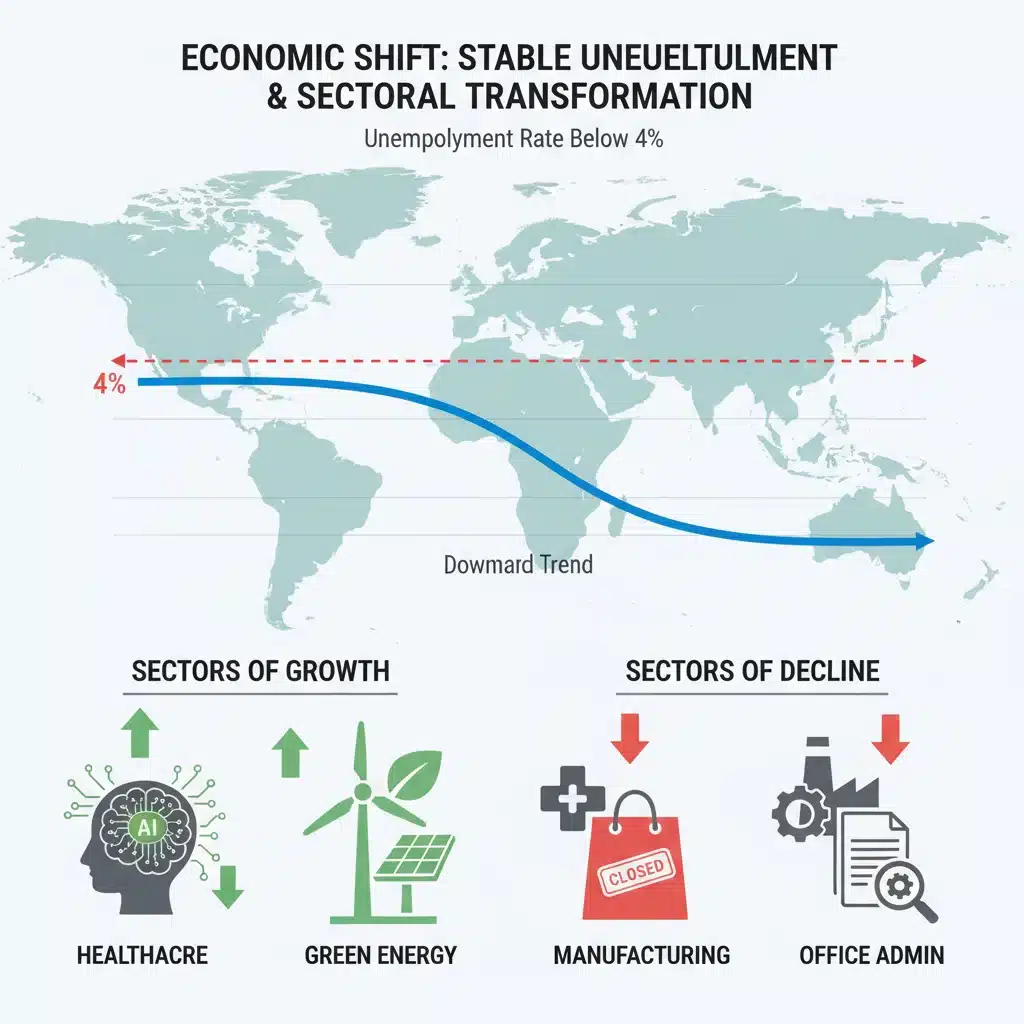
The concept of a stable unemployment rate below 4% is, on the surface, a testament to robust economic fundamentals and effective labor policies. However, delving deeper reveals a complex interplay of forces. Automation, artificial intelligence (AI), and advanced robotics are not just hypothetical future threats; they are actively reshaping industries, displacing some roles while simultaneously creating entirely new ones. The green economy, driven by urgent climate action, is blossoming, demanding specialized skills in renewable energy, sustainable manufacturing, and environmental remediation. Healthcare continues its relentless expansion, fueled by aging populations and medical innovation. Conversely, sectors grappling with automation or changing consumer behavior may face contraction or significant restructuring.
This article will dissect the multifaceted dynamics of the 2026 labor market. We will explore the key drivers behind the projected unemployment stability, analyze the specific sectors experiencing growth and decline, and discuss the implications for workforce development, education, and individual career planning. Our aim is to provide a comprehensive overview that equips stakeholders with the insights needed to navigate this intricate and opportunity-rich environment.
Anúncios
The Macroeconomic Picture: Sustained Low Unemployment
The forecast for a continued low unemployment rate in 2026, hovering below the 4% threshold, is largely predicated on several macroeconomic factors. Central banks globally are expected to maintain a delicate balance between controlling inflation and fostering economic growth, leading to conditions that support job creation. Fiscal policies, while varied by nation, are generally anticipated to avoid severe austerity measures that could stifle demand and employment. Consumer spending, a perennial engine of economic activity, is projected to remain resilient, buoyed by stable wages and a relatively healthy job market. Business investment, particularly in technology and infrastructure, will also play a crucial role in sustaining demand for labor, albeit often for highly skilled positions.
Furthermore, the lessons learned from recent economic disruptions, such as the COVID-19 pandemic, have equipped governments and businesses with more agile response mechanisms. Supply chain resilience, labor market flexibility, and digital transformation initiatives have accelerated, allowing economies to absorb shocks more effectively and maintain employment levels. The increasing adoption of remote and hybrid work models has also expanded the talent pool for many employers, potentially reducing frictional unemployment by matching workers with opportunities regardless of geographical proximity.
However, this optimistic outlook is not without its caveats. Geopolitical tensions, persistent inflation pressures, and potential financial market volatility could all introduce headwinds. The pace of technological change, while a driver of new jobs, also poses a risk if workforce reskilling and upskilling efforts fail to keep pace with the evolving demands. Therefore, while the headline unemployment figure provides a comforting sense of stability, a deeper dive into sectoral shifts reveals the true challenges and opportunities of the 2026 labor market.
Sectoral Shifts: The Undercurrents of Change in the 2026 Labor Market
While overall unemployment remains low, the composition of the workforce and the demand for specific skills are undergoing significant reconfigurations. These sectoral shifts are the defining characteristic of the 2026 labor market, creating winners and losers, and necessitating widespread adaptation.
Growth Sectors: Innovation and Essential Services
Several sectors are poised for robust growth, driven by fundamental societal needs and technological innovation:
- Technology and AI: This is arguably the most dynamic sector. Beyond core software development, there will be surging demand for AI specialists, machine learning engineers, data scientists, cybersecurity experts, cloud architects, and UX/UI designers. The integration of AI into nearly every industry means that roles focused on AI ethics, governance, and human-AI collaboration will also become critical.
- Healthcare and Biotechnology: An aging global population, coupled with advancements in medical science, ensures sustained growth. Beyond traditional roles, there will be increasing demand for telehealth specialists, genetic counselors, biostatisticians, bioinformatics scientists, and specialists in personalized medicine. Mental health services, particularly those delivered digitally, will also see continued expansion.
- Green Economy and Renewable Energy: The transition to a sustainable future is creating a plethora of new jobs. This includes engineers for renewable energy systems (solar, wind, geothermal), energy efficiency consultants, environmental scientists, sustainable agriculture specialists, waste management innovators, and experts in carbon capture technologies.
- Advanced Manufacturing and Robotics: Far from being a job destroyer, advanced manufacturing, often dubbed ‘Industry 4.0,’ requires a highly skilled workforce. Roles will include robotics technicians, automation engineers, industrial data analysts, and specialists in additive manufacturing (3D printing).
- Logistics and Supply Chain Management: The lessons from recent disruptions have highlighted the critical importance of resilient supply chains. This sector will see growth in roles focused on supply chain analytics, logistics automation, last-mile delivery optimization, and global trade compliance.
- Education and Workforce Development: As the pace of change accelerates, the need for continuous learning and reskilling will become paramount. This will drive demand for online learning specialists, corporate trainers, vocational educators, and career counselors who can guide individuals through career transitions in the evolving 2026 labor market.
These growth sectors are characterized by a high demand for specialized skills, often requiring a blend of technical expertise, critical thinking, and adaptability.
Declining or Transforming Sectors: The Impact of Automation and Shifting Demands
While some sectors thrive, others will face significant challenges or undergo profound transformations. This doesn’t necessarily mean the complete disappearance of jobs, but rather a redefinition of roles and a reduction in sheer numbers for certain occupations:
- Routine Administrative and Clerical Roles: Automation and AI-powered software will continue to streamline many back-office functions, impacting roles such as data entry clerks, administrative assistants focused on repetitive tasks, and certain accounting functions. The remaining roles will require more analytical and problem-solving skills.
- Traditional Retail: While brick-and-mortar retail will persist, the ongoing shift to e-commerce will continue to reshape the sector. Demand for traditional sales associates may decline, while roles in e-commerce logistics, digital marketing, and customer experience management will grow.
- Manufacturing (Low-Skilled, Repetitive): As advanced robotics become more sophisticated and cost-effective, jobs involving highly repetitive manual labor on assembly lines are likely to see further automation.
- Transportation (Certain Segments): The advent of autonomous vehicles, particularly in trucking and logistics, could significantly impact traditional driving roles over the long term, though this transition is expected to be gradual.
- Fossil Fuel Industries: As the world transitions to renewable energy, jobs directly tied to fossil fuel extraction and processing may see a gradual decline, necessitating a just transition for workers in these areas.
The key takeaway here is not widespread job destruction, but rather a significant shift in the nature of work. Many roles will be augmented by technology, requiring workers to collaborate with AI and automation rather than being replaced by it. This necessitates a proactive approach to skill development.
The Skill Gap: A Critical Challenge for the 2026 Labor Market
The divergence between the skills demanded by growing sectors and those possessed by the existing workforce represents one of the most significant challenges in the 2026 labor market. This skill gap isn’t just about technical proficiency; it also encompasses a range of ‘soft skills’ that are becoming increasingly vital.
In-Demand Skills for 2026 and Beyond:
- Digital Literacy and Tech Proficiency: Fundamental understanding of digital tools, data analysis, and increasingly, familiarity with AI applications.
- Critical Thinking and Problem Solving: The ability to analyze complex situations, identify root causes, and devise innovative solutions.
- Creativity and Innovation: As routine tasks are automated, human creativity in generating new ideas and approaches becomes more valuable.
- Adaptability and Lifelong Learning: The capacity to quickly learn new skills and adapt to changing work environments is paramount.
- Emotional Intelligence and Collaboration: Effective teamwork, communication, empathy, and leadership skills are crucial in increasingly interconnected and diverse workplaces.
- Data Fluency: The ability to interpret, analyze, and communicate insights from data, regardless of the specific industry.
- Green Skills: Knowledge and expertise related to sustainability, renewable energy, and environmental management.
Addressing this skill gap requires a concerted effort from multiple stakeholders: educational institutions, governments, businesses, and individuals themselves. Traditional education models must evolve to incorporate future-oriented skills, and continuous learning must become the norm rather than the exception.
Implications for Businesses and Policymakers
For businesses, understanding the evolving 2026 labor market is crucial for talent acquisition, retention, and strategic growth. Companies that fail to adapt their workforce strategies risk falling behind.
Business Strategies:
- Invest in Reskilling and Upskilling: Proactive investment in training programs for existing employees is more cost-effective than constantly seeking new talent in a tight market. Focus on developing both technical and soft skills.
- Embrace Hybrid Work Models: Offering flexibility can significantly enhance employee satisfaction, attract a wider talent pool, and improve productivity.
- Leverage AI for Workforce Planning: Use data analytics and AI tools to predict future skill needs, identify internal talent gaps, and optimize recruitment strategies.
- Foster a Culture of Continuous Learning: Encourage employees to engage in lifelong learning by providing access to courses, certifications, and mentorship opportunities.
- Focus on Employee Well-being: Mental health support, work-life balance initiatives, and inclusive work environments are critical for retaining talent.
- Strategic Partnerships: Collaborate with educational institutions, vocational schools, and government agencies to develop talent pipelines that meet specific industry needs.
Policy Recommendations:
- Modernize Education Systems: Governments should work with educators to integrate future-oriented skills into curricula from early education through higher learning.
- Support Lifelong Learning Initiatives: Implement policies that incentivize continuous education, such as tax credits for training, accessible online learning platforms, and robust career counseling services.
- Facilitate Labor Mobility: Policies that support workers transitioning between declining and growing sectors, including unemployment benefits linked to retraining, are essential.
- Invest in Digital Infrastructure: Ensure widespread access to high-speed internet and digital tools to enable remote work and digital learning across all demographics.
- Promote STEM and Green Skills: Targeted investments and incentives to encourage students and workers to pursue careers in science, technology, engineering, mathematics, and environmental fields.
- Address Inequality: Ensure that the benefits of technological advancement and economic growth are broadly shared, preventing a widening gap between highly skilled and lower-skilled workers.
The role of government and policy in shaping a resilient and equitable 2026 labor market cannot be overstated. Proactive measures can mitigate potential disruptions and maximize the opportunities presented by these shifts.

Implications for Individuals: Navigating Your Career in 2026
For individuals, the 2026 labor market demands a proactive and adaptive mindset. The days of a single career path are increasingly behind us. Instead, individuals must become architects of their own continuous professional development.
Strategies for Career Success:
- Embrace Lifelong Learning: This is no longer optional. Dedicate time regularly to acquire new skills, whether through online courses, certifications, workshops, or on-the-job training. Focus on skills that are transferable across industries.
- Develop a Hybrid Skillset: Combine technical expertise with strong soft skills. For example, a data analyst who can also communicate complex findings effectively is more valuable than one who only possesses technical prowess.
- Network Strategically: Build and maintain a strong professional network. Connections can open doors to new opportunities, mentorship, and insights into emerging trends.
- Consider Career Pivots: Be open to changing industries or roles, especially if your current field is undergoing significant automation or decline. Research growth sectors and identify how your existing skills can be adapted.
- Cultivate Digital Fluency: Regardless of your profession, a solid understanding of digital tools, data, and online communication is essential.
- Prioritize Well-being: The demands of a dynamic labor market can be taxing. Prioritizing mental and physical health ensures sustained performance and resilience.
- Seek Mentorship: Find experienced professionals who can offer guidance, share insights, and help you navigate career challenges.
The future of work is not about fearing automation, but about embracing collaboration with technology and continuously evolving one’s capabilities. The stability in overall unemployment should provide a degree of confidence, but the underlying shifts necessitate vigilance and adaptability.
The Role of Globalization and Geopolitics
Beyond technology and demographics, globalization and geopolitics will also exert a significant influence on the 2026 labor market. While some voices advocate for deglobalization, the interconnectedness of economies remains a dominant force. Global supply chains, though undergoing restructuring for resilience, will continue to shape manufacturing and logistics jobs. International trade agreements, or the lack thereof, can impact specific industries and regions.
Furthermore, the global competition for talent is intensifying. Countries and regions that can attract and retain skilled workers, particularly in high-growth sectors, will gain a significant economic advantage. This will lead to continued debates around immigration policies, international student programs, and the ease of cross-border talent mobility. Geopolitical stability, or instability, in key regions can also directly affect investment flows, commodity prices, and ultimately, employment levels in various sectors.
The rise of remote work has also blurred geographical boundaries for many jobs, leading to increased competition for certain roles but also opening up opportunities for individuals in regions with lower costs of living to access higher-paying jobs. This global talent arbitrage will continue to be a significant trend in the 2026 labor market.
Conclusion: A Dynamic Stability
The 2026 labor market presents a fascinating picture of dynamic stability. The projected unemployment rate, holding steadily below 4%, suggests a resilient economy capable of generating sufficient jobs. However, this stability is merely the surface of a much deeper transformation. Beneath it, powerful currents of technological innovation, demographic shifts, and evolving global dynamics are reshaping industries and redefining the skills required for success.
For businesses, this means a continuous focus on workforce development, strategic talent acquisition, and fostering adaptive organizational cultures. For policymakers, it necessitates forward-thinking investments in education, infrastructure, and social safety nets that support workers through transitions. And for individuals, it underscores the critical importance of lifelong learning, adaptability, and cultivating a diverse skill set that can thrive amidst change.
The future of work in 2026 is not about fearing automation, but about embracing collaboration with technology and continuously evolving one’s capabilities. The stability in overall unemployment should provide a degree of confidence, but the underlying shifts necessitate vigilance and adaptability.